


The U.S. has a surplus of light hydrocarbon liquids – much of it in the form of field condensate produced at the wellhead and plant condensate extracted from natural gas at processing plants. Declining domestic demand leaves both field and plant condensate increasingly reliant on export markets. Trouble is those export markets are far from secure and the oil price crash isn’t making things any easier. Today we preview RBN’s latest Drill Down report – a deep dive into the supply and demand balance for field and plant condensate.
What follows is based on our latest Drill Down report – available exclusively to RBN Backstage Pass subscribers. The report describes the extraction and production of both field and plant condensate in the U.S. We provide actual and forecast production data as well as an explanation of markets for condensate today and over the next five years. We explain why both types of condensate are headed for a surplus in the domestic market and evaluate possible export markets that could soak up that surplus. Finally we discuss the increasing possibility that export markets may not be able to absorb the U.S. condensate surplus and how that likelihood has increased following the recent oil price crash. To read more about the report or to download a copy, please click on the link below.
Crude production from the current shale boom is generally lighter as measured in API degrees gravity than traditional supplies from conventional production. In fact an increasing quantity of crude output is more correctly termed condensate – a very light hydrocarbon with gravity over 50 degrees API. Although the EIA classifies condensate produced at the wellhead (known as field or lease condensate) as crude oil, in fact it is mostly recovered from the gas stream. Production of field condensate in the U.S. has increased from about 450 Mb/d in 2009 to 1.2 MMb/d in 2014 and could increase to 1.8 MMb/d over the next 5 years depending on a number of factors, the most important of which is the price of crude oil. Over the past few weeks, field condensate prices have declined as much or more than crude oil prices. (see Figure #1 – a version of this chart with production by basin is included in the report). Note that this outlook incorporates RBN’s Growth Scenario, which is based on a number of factors which support continued increases in crude and condensate production even after recent crude oil price declines.
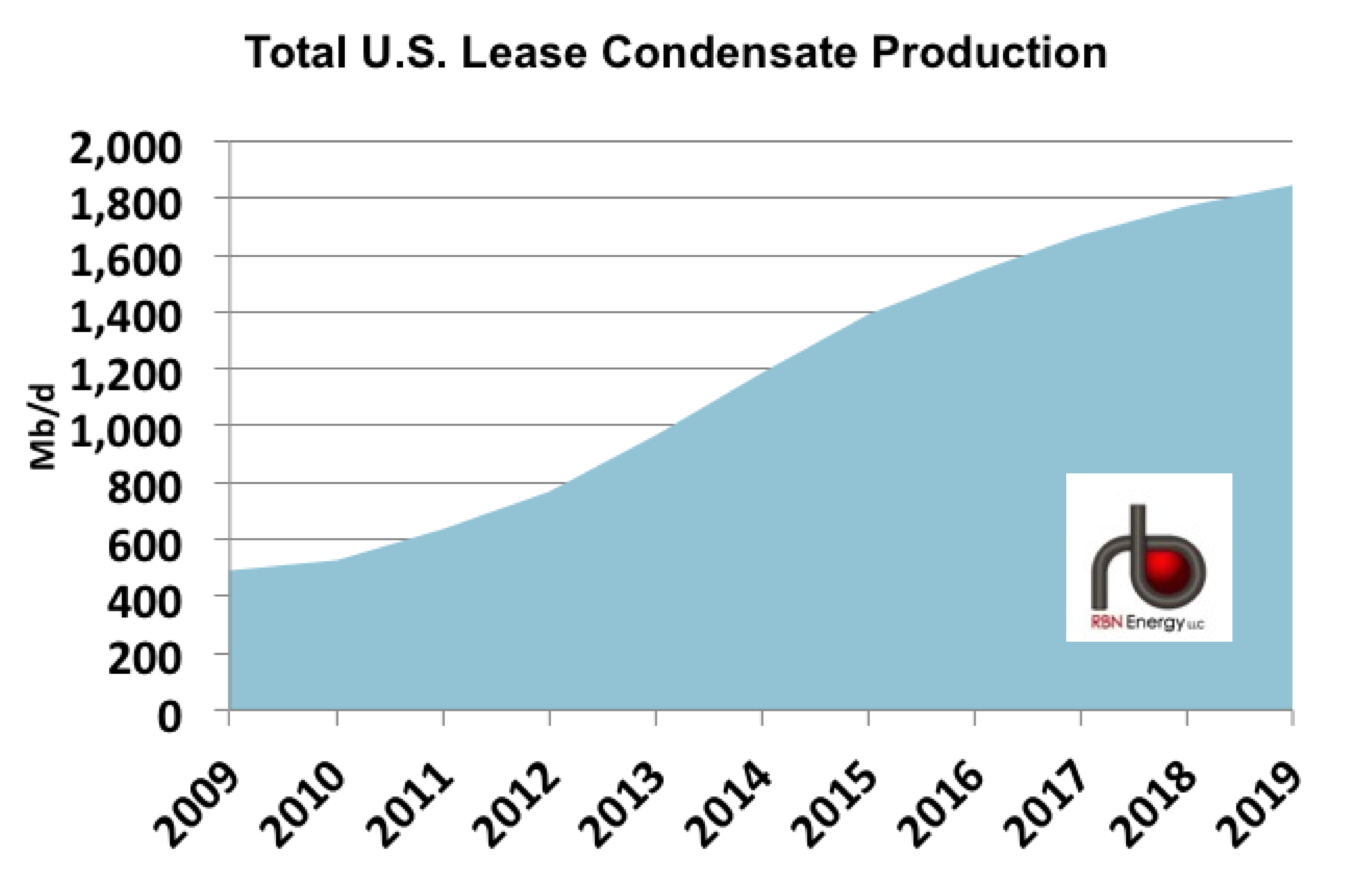
Figure #1

About the song
"Blinded by the Light" is a song written and originally recorded by Bruce Springsteen, although it is mostly known by its 1977 #1 hit version recorded by Manfred Mann's Earth Band.







Comments
Won't the condensate that is used as diluent just get extracted at a splitter and then sent via pipeline to to Canada to be used again?
Great work. I read all of your daily blogs. It's the best info out there for me. Happy holidays.
This may sound very crazy, but,.......if condensates get cheap, could they be used as fueler additives in non-traditional applications? For example to boost BTU inputs for scrap pre-heating at steel mills, clean BTU source for glass plants, brick plants, ceramics production. Or, catalytically split and sell product in the ethane/propane/butane stream???
Just asking! I am a MEch Engineer not a ChemEng but certainly this BTU source can be advantageously used in newer wats!
Don't you think that there are other downstream players in the Asian market that will demand condensates even if they are not demanded as cracker feeds? Refineries over there typically get a lot of heavy crude and might be amenable to the idea of buying condensates to blend with the heavy crude to an extent. What's your opinion on this?