


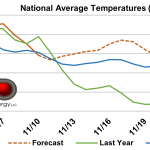
The December CME/NYMEX Henry Hub gas futures contract settled at $3.033/MMBtu Friday, down nearly 50 cents (14%) vs. the previous Friday as weather forecasts moderated significantly, particularly for the back half of November, and production rose to a record high that topped 105 Bcf/d in the NATGAS Billboard model.
Featured Articles


- Blog
Oops, (Winter's) Out of Time - Natural Gas Buyers Party Like It's 1999
After holding above $2/MMBtu in the first half of January, the CME/NYMEX February natural gas futures contract caved in this week, closing Tuesday and Wednesday at $1.895/MMBtu and $1.905/MMBtu, respectively. The last time we saw prices this low was in March 2016. But to see such levels trading in January, typically one of the coldest and highest-demand months of the year, you’d have to go back more than two decades — to 1999. Today, we explain the fundamentals behind the price collapse earlier this week and its implications for the 2020 gas market.


- Blog
Arctic Shuffle - February Polar Vortex Effect Puts $3/MMBtu Gas Prices Back in Play
Weather is the perpetual wildcard in the natural gas market, but it’s been particularly shifty this winter, keeping market participants — and weather forecasters, for that matter — on their toes. Gas futures prices started this season at $3.30-plus/MMBtu, but then endured some of the warmest weather on record (in November and January), including a couple of polar vortex head fakes over the past month or so — weather forecasts at times in January started off much colder but ultimately reversed course. Prompt CME/NYMEX Henry Hub futures prices have seesawed as a result. Despite the weather setbacks, however, prices have held on in the $2.40-$2.70/MMBtu range through much of winter and averaged more than $0.60/MMBtu higher year-on-year in January. And, with an Arctic blast set to unfurl across the Lower 48 this week, prices last Friday topped $3/MMBtu again in intraday trading before settling in the high-$2.80s/MMBtu Friday and Monday. Today, we examine the supply-demand factors underlying the recent price action, and prospects for sustained $3/MMBtu gas prices.


- Blog
The Final Countdown - Bearish 2023 Gas Market Punctuates Last Throes of Shale Era Abundance
The Lower 48 natural gas market has had the most bearish start to a new year in a long time. Production has been at record highs, an exceptionally warm start to January suppressed demand, and LNG exports have been hobbled since last June when Freeport LNG went offline. The CME/NYMEX Henry Hub February gas futures contract slid to an 18-month low of $2.94/MMBtu last Thursday and expired Friday at $3.109/MMBtu, down 54% from where the prompt contract closed just two months earlier. The March contract extended the slide Monday to a 20-month low of $2.677/MMBtu. Freeport’s eventual return will restore existing export capacity, but there’s no new LNG export capacity due online this year — for the first time since 2016. After one of the tightest gas markets of the last decade in 2022, the stage is set for one of the most oversupplied markets we’ve seen in years. But the bulls out there can take solace: 2023 will also mark the final throes of the kind of oversupply conditions that defined the Shale Era as we know it. In today’s RBN blog, we discuss how we got here and RBN’s outlook for natural gas supply and demand.
