


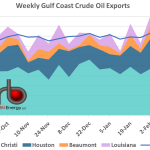
The customary week-to-week volatilty in U.S. crude export volume is slowly resolving into an upward trend. After a much smaller than usual decline this week from 4.6 MMb/d to 4.3 MMb/d, there is a clear trend developing, with the 4 week moving average, (blue line in chart below) clearly rising from what was a stubborn 3.8-4.1 MMb/d value to 4.3 MMb/d.
Featured Articles
- Analyst Insight
Beaumont Shutout of US Crude Exports
Beaumont Shutout of US Crude Exports for the first time since August.


- Blog
One Week - A Record Seven Days for Gulf Coast Crude Exports, and a Lot More
The level of activity at crude oil export terminals from Corpus Christi to the Louisiana Offshore Oil Port (LOOP) is nothing short of extraordinary — a record 4.8 MMb/d was loaded the week ended August 25, according to RBN’s Crude Voyager report, and Houston-area terminals loaded an all-time high of 1.4 MMb/d. But there’s a lot more to the crude exports story. When you live this stuff day-in, day-out, you see subtle changes that often extend into trends and, if you’re lucky, you sometimes get signals that things you’d been predicting are actually happening. In today’s RBN blog, we discuss highlights from the latest Crude Voyager and what the weekly report’s data and analysis reveal about the global oil market.


- Blog
Slow Train Coming - Canadian Crude Rail Load Terminals Overbuilt and Underutilized
RBN estimates that midstream companies have built out about 950 Mb/d of crude-by-rail (CBR) loading terminal capacity in Western Canada. Data from the Energy Information Administration (EIA) shows actual CBR shipments from Canada to the U.S. topped out at 195 Mb/d in January 2015 and have fallen by 40% since then. Hard-pressed Canadian producers have been squeezed by lower prices and high transport costs with only limited relief as new pipelines came online. Today we review the fate of Canadian CBR transport capacity.
