


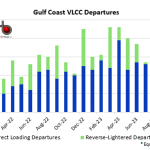
A record number of tankers that loaded shipments directly at Gulf Coast export terminals transferred their cargoes onto Very Large Crude Carriers (VLCCs) in the last two weeks as reported in the RBN Crude Voyager report. Reverse-lightering, which is typically a complex, time-consuming and an expensive process, is often noted between tankers in the lightering zones as the terminal depths are not deep enough to support a fully laden VLCC. Thirteen tankers reverse-lightered their shipments onto VLCCs in the week ended October 20 — setting a new record for a single week.
Featured Articles
- Analyst Insight
Surge in VLCC Presence in USGC Set to Drive Growth in Crude Oil Exports
Crude oil exports from the U.S. Gulf Coast posted the largest gain in nine weeks, rising by 521 Mb/d as terminals collectively loaded over 4.1 MMb/d in the week ended August 18 as per the weekly Crude Voyager report. Additionally, thirteen VLCCs entered the Gulf of Mexico last week for loading – the highest in four months.


- Blog
Berth in Reverse - Reverse-Lightering Crude Oil Supertankers Along the Gulf Coast
There’s a reason why more than half a dozen midstream companies and joint ventures are clamoring to build deepwater loading terminals on the Gulf of Mexico: because it’s a major pain to load Very Large Crude Carriers (VLCCs) any other way. These days, the standard operating procedure for loading the vast majority of VLCCs along the Gulf Coast involves a complex, time-consuming and costly process of ship-to-ship transfers called reverse-lightering, in which smaller tankers ferry out and transfer crude to VLCCs in specified lightering areas off the coast. Today, we ponder the current dynamics for U.S. crude exports via VLCC.


- Blog
Standing on the Shore - Suddenly, a Slew of Gulf Coast Crude Loadings Onto VLCCs
In 2018, a handful of midstream companies started racing to develop deepwater export terminals along the Gulf Coast that can fully load Very Large Crude Carriers (VLCCs) with 2 MMbbl of crude oil from the Permian and other plays. While some of those companies are moving toward final investment decisions (FIDs) that would bring their plans to fruition in the early 2020s, terminal operators with existing VLCC-capable assets — both onshore and offshore — turned up the volume in a major way in December. Today, we outline the strides made in recent days by the export programs of the Louisiana Offshore Oil Port (LOOP), Seaway Texas City and Moda Midstream.
