


Last week’s crude rally lifted benchmarks to multi-month highs, but left Canadian heavy barrels struggling to stay afloat. As discussed in this week’s Tradeview Report, amidst the close of the November trade cycle and continued geopolitical tensions, prompt Brent skyrocketed more than 6% week-over-week to settle at $116.72/bbl Friday, its highest settlement since late April, while December WTI ended Friday at $103.27/bbl, the highest end-of-week close since May.
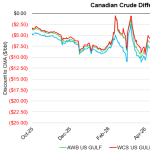
In contrast, Canadian heavy crude found little comfort in a rising oil market. Growing oil sands supply and exceptionally expensive freight have weakened Canadian barrels’ competitive position, forcing sellers to offer deeper discounts even as global crude prices climbed. For the week ended October 23, the differential of Western Canadian Select delivered to the Gulf Coast (WCS US Gulf or red line in chart below) widened 18% to a steep ($22.28)/bbl discount below the NYMEX-CME Calendar Month Average (CMA), dropping to its weakest differential since October 2022. Additionally, Access Western Blend (AWB) at the Gulf Coast (green line) and Cold Lake at Patoka (blue line) plummeted to ($24.50)/bbl and ($24.85)/bbl below CMA, respectively, the lowest differentials since RBN’s records began in 2018.
For context, CMA stands for Calendar Month Average, representing the average of the daily front-month NYMEX WTI settlement prices over a calendar month. CMA is used as it is an accurate indication of WTI NYMEX pricing during the period when the physical crude is delivered.

