


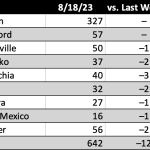
The slow decline for US oil and gas rig count continued this week, with total rig count at 642 for the week ending August 18, a decline of 12 vs. a week ago according to Baker Hughes. No basins added rigs, while most posted declines including Appalachia (-3), Anadarko (-2), Bakken (-2), Haynesville (-1), Niobrara (-1), Gulf of Mexico (-1) and All Other (-2). Total rig count is down 78 in the past 90 days, and down 120 vs. this week one year ago. Oil directed rigs were down five, while gas directed rigs were down six and miscellaneous rigs were down one.
Featured Articles
- Analyst Insight
US Rig Count Continues To Stagnate, Remains at 621 Rigs
US oil and gas rig count continues to be stagnant, with total US rigs at 621 for the week ending January 26 according to Baker Hughes, a gain of one vs. a week ago. Rigs were added in the Permian (+3) and Niobrara (+1), while the Eagle Ford (-1), Haynesville (-1) and Gulf of Mexico (-1) all lost rigs. Total US rig count is down four in the last 90 days, and down 150 vs. this week a year ago.
- Analyst Insight
US Rig Count Slides To 576 On Losses in Permian
US oil and gas rig count fell to 576 for the week ending January 24, a decline of four vs. a week ago and marking the first week below 580 in four years according to Baker Hughes data. Rigs were added in the Eagle Ford (+2) and Anadarko (+1), while the Permian (-6) and All Other (-1) both posted week-on-week declines. Total US rig count is down nine in the last 90 days, and down 45 from this week a year ago. Oil-directed rigs stand at 472 (-6), while gas-directed rigs stand at 99 (+1) and miscellaneous rigs at five (+1).


- Blog
Back On Top - Natural Gas Production from Crude-Focused Basins Growing Again
Lower-48 natural gas production has climbed more than 4.0 Bcf/d in the past 10 months. While Marcellus/Utica activity continues to drive the bulk of the recent increases in total volumes, crude-focused basins, like the Permian and SCOOP/STACK plays, also are picking up steam as a new generation of oil rigs is deployed to the fields and vying for market share. In other words, production growth is no longer a one-man — uh, one-basin — show. Today, we look at what’s happening with gas production outside the Northeast.
