


On the Western Midstream (WES) Q3 earnings call, management said their Delaware gas throughput volumes rose 20% from Q2 to a record 2.56 Bcf/d. About two-thirds of that came from the former Brazos Delaware system which was acquired back in Q2. Delaware water volumes hit another record of about 3 MMb/d. Gas and water now make up about 85% of the earnings from WES’s operating assets, and its biggest projects are aimed at moving more of both. As CEO Oscar Brown puts it "We expect these trends to continue as both gas-to-oil and water-to-oil ratios continue to increase and move in the midstream provider’s favor."
On the gas side, North Loving II, a 300-MMcf/d processing train in Loving County, TX, is still set to start up in late Q1 2027. Management also noted that the company has already ordered long-lead equipment for another plant of about 300 MMcf/d and plans to formally approve it in early 2027. Farther out, WES now has a 7.5% stake in the Solitude Pipeline System, announced earlier in the quarter, which will add 2.25 Bcf/d of natural gas takeaway capacity from the Permian to Katy in late 2029 and another 2.25 Bcf/d by the end of 2030.
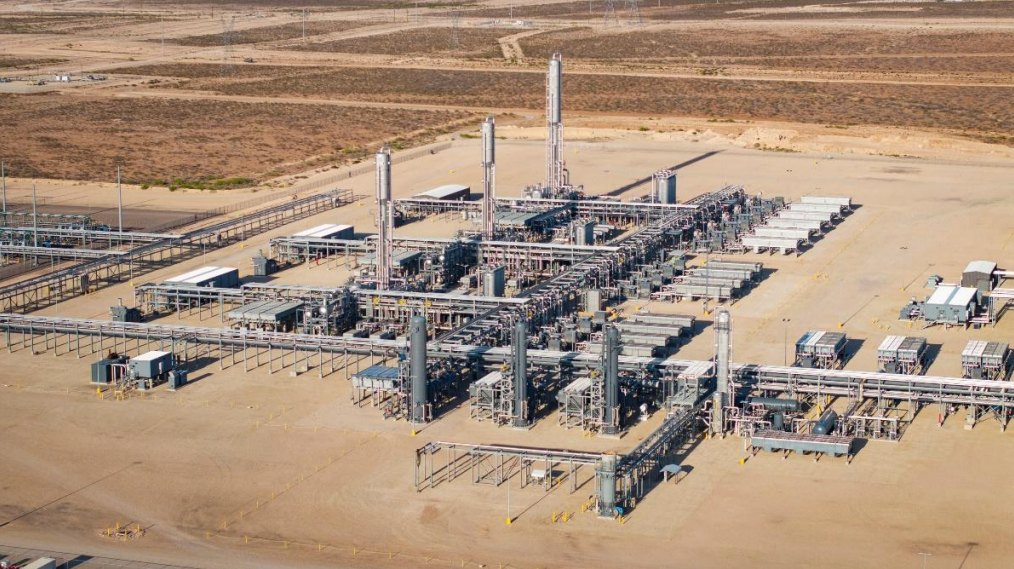
A WES gas processing plant in West Texas
On the water side, the 42-mile, 800-Mb/d Pathfinder pipeline starts up late this year, moving produced water from the busiest parts of the Delaware to disposal wells in eastern Loving County. When asked about how fast volumes would ramp up on the new pipeline, Brown mentioned “We’ve supersized it,” well beyond its Occidental anchor contract of 280 Mb/d cited in the investor presentation, because the pipeline is “allowing us to bring … more business than we could have otherwise all across our system, where we would have been potentially constrained by local disposal issues.” WES also paid about $98 million for a small water gathering and disposal system in Eddy County, NM, to add disposal capacity. Finally, management hopes to approve its first commercial plant to treat produced water for reuse within about six months.
