


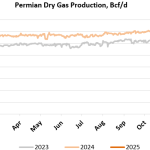
Natural gas production in the Permian Basin was relatively strong between 20.28 to 20.48 Bcf/d last week but then dropped by nearly 0.5 Bcf/d on Sunday as temperatures in the basin plummeted. Production levels dropped to 19.65 Bcf/d on Monday. Temperatures are expected to remain low through Tuesday before starting to rise later in the week. Impacts from freeze-offs will likely remain for a few days but abate by the end of the week. Weather is expected to be much warmer for the rest of January and into early February, according to weather forecasts, limiting risk for production freeze-offs. The overall impact to production will likely be short lived and relatively mild, unless cold temperatures persist. Even with the downward jolt on Monday, production was still 1.6 Bcf/d higher than during the same day last year, as seen in the chart below.
Featured Articles


East is East, West is West - U.S. Natural Gas Spot Prices Race to $600/MMBtu as Midcon Runs Out of Gas
Physical natural gas spot prices in the U.S. Midcontinent trading as high as $600/MMBtu, while Northeast prices barely flinch – that was the upside-down reality physical traders were contending with Friday in trading for the long weekend, with Winter Storm Uri bearing down on large swaths of the Lower 48 and spreading bitter-cold, icy weather from the Midwest and Northeast to Texas and the Deep South. The record-shattering, triple-digit spot prices, mostly all west of the Mississippi River, were indicative of some of the worst supply shortages the market has seen during the generally oversupplied Shale Era, or ever. But the East vs. West price divergence also marks the culmination of years of shifting gas supply and flow patterns that have redefined regional dynamics. The market will be digesting the various impacts of this still-unfolding event for days, but some of the effects and implications can be gleaned already from daily pipeline flows. In today’s blog we provide an early look at the market impacts of the polar plunge.


Oops, (Winter's) Out of Time - Natural Gas Buyers Party Like It's 1999
After holding above $2/MMBtu in the first half of January, the CME/NYMEX February natural gas futures contract caved in this week, closing Tuesday and Wednesday at $1.895/MMBtu and $1.905/MMBtu, respectively. The last time we saw prices this low was in March 2016. But to see such levels trading in January, typically one of the coldest and highest-demand months of the year, you’d have to go back more than two decades — to 1999. Today, we explain the fundamentals behind the price collapse earlier this week and its implications for the 2020 gas market.


Terminal Frost - Extreme Cold Wreaks Havoc with Natural Gas Producers, Power Generators, and Everybody in Between
If you’re reading this, it means you’ve got access to power and internet. Count yourself among the fortunate today. Rolling blackouts and brownouts across the middle of the country and in Texas, have disrupted businesses and lives. It’s been particularly brutal in the Lone Star State. Electricity and natural gas are commodities that are so basic to our way of living that it’s easy to take for granted the efforts designed to make them reliable, available, and affordable. But, boy, does it make things difficult when they don’t show up as anticipated. In today’s blog, we discuss the factors behind the supply disruptions that are wreaking havoc in these commodity markets.
