


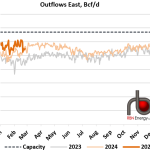
Overall outflows of gas from the Permian Basin were down 0.76 Bcf/d, driven by the midweek freeze offs, with outflows on all routes except to Mexico down week-on-week. Outflows to the East averaged 11 Bcf/d, down 0.77 Bcf/d week-on-week. These outflows were high at the beginning of the week but dropped with production levels. The drop can be seen in the bold orange line in the chart below. Reported outflows on all greenfield pipelines were down midweek but are already rebounding. Reported deliveries on Matterhorn Express dropped to just above 1 Bcf/d on February 19, but are now back around 1.5 Bcf/d.
Featured Articles
- Analyst Insight
Ascent of Matterhorn Causes Waha Gas Prices to Climb
Measurable flows of natural gas began on Matterhorn at the beginning of this month. Although not as long in the making as the Karl Marlantes novel of the same name, Matterhorn has been hotly anticipated this year and will greatly impact gas flows and basis prices in Texas.


- Blog
Shake, Rattle and Roll - Oklahoma Earthquakes and Risks to the Crude Oil Hub at Cushing
In 2015, Sooners held on tight as Oklahoma was rocked by 890 earthquakes with a magnitude of 3 or higher—up sharply from only 43 earthquakes in 2010 and an average of less than two earthquakes per year in the previous quarter-century. Oklahomans have experienced hundreds of earthquakes this year too, including a record-breaking 5.8 event on September 3 and, on November 6, a 5.0 quake very near Cushing, OK, which serves as the delivery point for the CME/NYMEX Light Sweet Crude contract and which has earned the nickname “Pipeline Crossroads of the World”. Today we look at the latest quake near Cushing and other recent pipeline disruptions to assess the resilience of critical crude-delivery systems.


- Blog
I Feel the Earth Move - Is Seismic Activity a Threat to Permian Crude Production Growth?
Even through the market turmoil of the past couple of years, the Permian has been a production powerhouse, lately churning out an average of nearly 5 MMb/d of crude oil and 14 Bcf/d of natural gas. But is the Permian on shaky ground? Well, sort of. Distinct areas within both the Midland and Delaware basins in West Texas have experienced an increasing number of higher-magnitude earthquakes that have been linked to the saltwater disposal (SWD) wells that E&Ps use to get rid of the massive volumes of “produced water” their oil and gas operations generate. As a result, regulators have been ordering some of these disposal wells to be shut down and directing producers and midstreamers to develop “seismic response action plans” aimed at reducing the frequency and severity of quakes. In today’s RBN blog, we look at what has been happening on the earthquake front in West Texas and how E&Ps can deal with it.
