


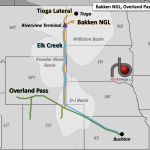
With associated gas volumes continuing to rise in the Williston basin, NGL production has also been driven higher. To accommodate the increasing NGLs, ONEOK has announced plans to expand the 300 Mb/d Elk Creek pipeline. The pipeline runs NGLs from ONEOK’s Riverview terminal in Richland County, MT down the western edge of Wyoming, then skirts to the left to end up at Bushton KS. The expansion will add an additional 100 Mb/d of NGL capacity, bringing the total takeaway capacity to 400 Mb/d. ONEOK had announced the estimated $305 million expansion in early 2020, stating they would construct 10 pump stations along the line. By some indications, the additional capacity could come online sooner rather than later.
Featured Articles


- Blog
I Can Help - How ONEOK's New Elk Creek NGL Pipeline Makes Things Better in the Williston Basin
Much as production growth in the Permian required the development of new pipeline capacity to take away crude oil, natural gas and NGLs, increasing activity in the Williston Basin has spurred the need for incremental capacity to move all three of the energy commodities out of western North Dakota and eastern Montana. For NGLs, the recent start-up of ONEOK’s Elk Creek Pipeline has been the answer to producers’ prayers — not just in the Williston Basin (home of the Bakken formation), but also in the Rockies’ Powder River and the Denver-Julesburg (D-J) basins, through which the new, 240-Mb/d pipeline passes on its way to Bushton, KS. Elk Creek’s timing couldn’t have been better: it came online just as a number of new gas processing plants entered commercial service in the Williston Basin, and just in advance of possible Btu restrictions on the all-important Northern Border gas pipeline that may force cutbacks in ethane rejection. Today, we explain why the Elk Creek NGL Pipeline helps resolve a number of challenges Bakken producers have been facing.


- Blog
Thank You - ONEOK's Plan to Boost Bakken and Niobrara/DJ Basin NGL Takeaway Capacity
There has been growing concern regarding NGL pipeline takeaway capacity out of the Williston Basin and the Niobrara — particularly the DJ Basin — over the past year, with one of the major pipes through those regions now running full. Finally, ONEOK has announced plans for the Elk Creek Pipeline, which will have an initial capacity of 240 Mb/d and be expandable to 400 Mb/d. The new pipe will transport mixed, unfractionated NGLs from eastern Montana to the Conway/Bushton fractionation hub in central Kansas, and provide long-term relief for a lot of Bakken, Powder River and Denver-Julesburg (DJ) Basin producers. But with an end-of-2019 in-service date, will the new capacity come soon enough to avert NGL takeaway constraints? Today, we discuss the Elk Creek project, the flows on existing NGL pipes to Conway/Bushton, and the growing significance of ethane as pipelines fill.


- Blog
Push and Shove - Bakken Gas Muscling Out Western Canadian Supply From Chicago Market
The battle between Bakken and Western Canadian natural gas supplies for the Chicago market seems to be advancing toward a final showdown of sorts. Associated gas production from the crude-focused Bakken has been rising sharply, but capacity on the Bakken’s two gas takeaway pipelines — Northern Border and Alliance, also utilized by Western Canadian Sedimentary Basin (WCSB) supplies — has been maxed out for a few years now. The result is that Bakken gas is increasingly encroaching on — and pushing back — imports from the WCSB. Bakken gas flows already overtook Canadian gas receipts on Northern Border a year ago. Since then, the gas-on-gas competition and the resulting pipeline constraints have escalated, and things are likely to get worse. Today, we break down the forces at play in the competition for market access.
