


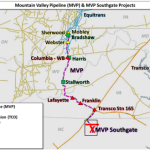
Equitrans Midstream announced on Tuesday (2/20) that completion of the Mountain Valley Pipeline would be delayed until the second quarter of 2024. The company stated in its earnings report that adverse weather conditions were the primary reason for the delay, as rainfall in West Virginia and Virginia was well above the norm. The company also held the rainy weather responsible for cost overruns, and the project is now expected to cost $7.7 billion overall.
Featured Articles


- Blog
Slippin' and Slidin' - MVP Delay Risks Amplifying Appalachia's Re-emerging Gas Takeaway Constraints
Appalachia natural gas producers hoping to get a big boost in pipeline takeaway capacity later this year were dealt some bad news recently. On May 4, Equitrans Midstream officially pushed back the in-service date for the already-delayed Mountain Valley Pipeline. The 2-Bcf/d, greenfield project is the last of the major planned expansions that would add substantial capacity from the prolific Appalachia gas-producing region and help stave off severe seasonal pipeline constraints, at least in the near- to midterm. Previous guidance had it coming online late this year, but Equitrans said it is now targeting start-up in the summer of 2022, pending water and wetland crossing permit reviews. The news is far from surprising considering the numerous regulatory and legal challenges midstream projects, including MVP, have previously faced in the Northeast over the past decade or so. But the resulting uncertainty leaves Northeast producers in a tight spot. In today’s blog, we will consider the implications of the MVP delay for Appalachia’s outflows.


- Blog
Signs of Life, Part 2 - Transco Corridor Expansions Give Appalachian Gas Producers a Way Out
When it comes to midstream development in the Northeast, Appalachian natural gas producers have learned by now not to hold their breath. The region is notorious for its staunch environmental opposition to hydrocarbon infrastructure and its propensity for sending gas pipeline projects to the trash pile. Against all odds, however, midstream development in the region has thawed in recent months, in large part spurred by the unlikely advancement of Mountain Valley Pipeline (MVP), the long-embattled project to move up to 2 Bcf/d from the Appalachia gas supply basin to the Transco Corridor, which runs north-south along the Eastern Seaboard. In today’s RBN blog, we take a look at historical flows on Williams’s Transco Pipeline and what they can tell us about how MVP and Transco’s own planned expansions might reshape gas flows along the corridor.


- Blog
Signs of Life - Williams's Transco Corridor Expansions Give Appalachian Gas Producers a Way Out
Appalachian natural gas producers got good news earlier this month: Williams announced it was moving forward with the Southeast Supply Enhancement project, a large-scale expansion of southbound capacity out of the Northeast on its Transco Pipeline system. Not only that, but it super-sized the project to 1.4 Bcf/d of capacity — nearly double the 800 MMcf/d it had offered in an open season held this summer. The project is one of several brownfield expansions planned to provide additional supply access in Transco’s premium Zone 5 market area, which runs through Virginia and North Carolina — and the first large-scale takeaway expansion to be announced in the area since the long-delayed Mountain Valley Pipeline (MVP) was cleared for completion following years of regulatory and legal hurdles. In today’s RBN blog, we provide the latest on the Transco Corridor expansions.
