


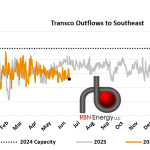
A decade after it was first announced and following six years of construction, Mountain Valley Pipeline (MVP) is finally ready to enter service. Equitrans Midstream wrote in a letter to the Federal Energy Regulatory Commission (FERC) on Monday that MVP is “mechanically complete.” In response, FERC issued a letter on Tuesday granting MVP the ability to begin operating. Although MVP is not flowing gas yet, the company has indicated that a start to operations is imminent. The announcement brought some bearish news to a week dominated by bullish weather forecasts.
Featured Articles


- Blog
Slippin' and Slidin' - MVP Delay Risks Amplifying Appalachia's Re-emerging Gas Takeaway Constraints
Appalachia natural gas producers hoping to get a big boost in pipeline takeaway capacity later this year were dealt some bad news recently. On May 4, Equitrans Midstream officially pushed back the in-service date for the already-delayed Mountain Valley Pipeline. The 2-Bcf/d, greenfield project is the last of the major planned expansions that would add substantial capacity from the prolific Appalachia gas-producing region and help stave off severe seasonal pipeline constraints, at least in the near- to midterm. Previous guidance had it coming online late this year, but Equitrans said it is now targeting start-up in the summer of 2022, pending water and wetland crossing permit reviews. The news is far from surprising considering the numerous regulatory and legal challenges midstream projects, including MVP, have previously faced in the Northeast over the past decade or so. But the resulting uncertainty leaves Northeast producers in a tight spot. In today’s blog, we will consider the implications of the MVP delay for Appalachia’s outflows.


- Blog
Shattered Dreams - After MVP Setback, Is the Appalachia Gas Forward Curve Wrong?
There was no shortage of drama in the U.S. natural gas market last week. The February Henry Hub CME/NYMEX contract expired in a blaze of glory after frenzied short-covering led to the largest single-day percentage gain since Henry futures began trading in the 1990s. The Northeast was bracing for a weekend “bomb cyclone,” a particularly gnarly nor’easter that brought frigid temperatures and threatened to disrupt the market just as heating demand spiked. But there was another, more subtle but still seismic event that occurred, one that is likely to reverberate well beyond the near-term horizon. Namely, the Equitrans Midstream-led, 2-Bcf/d Mountain Valley Pipeline — the only major expansion project left for increasing egress out of the Appalachian gas supply basin — lost two key federal permits, all but ensuring that the long-delayed project will miss its latest target in-service date of this summer, and potentially be held back another year, or more. In our Top 10 Prognostications for 2022 blog, #7 predicted more severe capacity constraints and weaker basis differentials for Appalachian gas producers. This is the latest indication that things could get worse — and sooner — than previously expected. In today’s RBN blog, we focus on our latest outlook for Appalachia’s gas takeaway constraints and basis pricing.


- Blog
Bring It On Home, Part 2 - MVP Optimism Spurs Williams/Transco Gas Midstream Expansions
It took an “Act of Congress” and a decision from the highest court in the land — handed down by the Chief Justice no less — but it’s looking more and more like Mountain Valley Pipeline (MVP) will be completed as early as by the end of this year, opening up 2 Bcf/d of new takeaway capacity for the increasingly pipeline-constrained Appalachian gas supply basin. That’s shifted the industry’s gaze to bottlenecks downstream of where the bulk of the volumes flowing on the new pipeline will land — on the doorstep of Williams’s Transco Pipeline in southern Virginia. A number of midstream expansions have been announced to capture the influx of natural gas supply from MVP and shuttle it to downstream markets in the Mid-Atlantic and Southeast regions, and indications are that more will be announced and greenlighted in the coming months. These projects will be key to both enabling gas production growth in the Appalachia basin as well as meeting growing gas demand in the premium markets lying on the other side of the constraints. In today’s RBN blog, we delve into the details and timing of the announced expansion projects vying to increase market access to MVP supply.
