


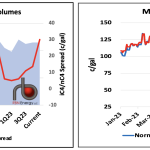
The Mont Belvieu iso-normal price spread reached a year-to-date high of 34 cents/gal on November 3, the widest differential since hitting 47 cents/gal on August 23, 2022. As the left-hand chart below illustrates, the spread between iso and normal can swing widely depending upon the relative supply/demand balances for the two products. For the first nine months of this year the differential ranged between minus two cents/gal and 28 cents/gal, averaging seven cents/gal, while in 2021 it was barely above zero. So what has been driving the big jump in the spread between isobutane and normal butane lately? The main culprit has been strong isobutane prices which have been bolstered by tight supply/demand balances. As shown on the right-hand chart below, the OPIS Mont Belvieu ("MB") non-TET isobutane price (red line) has rallied from ~90 cents/gal on October 12th to about 114 cents/gal currently, while normal butane prices (blue line) have barely budged. On the supply side, Enterprise’s three isomerization (“Isom”) units in Mont Belvieu continue to run full out with operating rates of 97% during the third quarter and 100%+ during the second quarter (per Enterprise 10Q filings). And its not just the Gulf Coast Isom operators who are reaping all of the profits with the Conway iso-normal spread hitting a whopping 43 c/gal on November 6th. It remains to be seen how long the differential will stay elevated, but it is unusual for it to be this wide at the beginning of winter.
Featured Articles


You Can Just Iso my Butane: Isobutane and Isomerization in the Shale Gas World
Of the five natural gas liquids (NGLs), isobutane stands apart in its sources and markets. Isobutane comes from gas processing plants and refineries, but it is also the only NGL intentionally made from another NGL – it’s cousin, normal butane. It has a variety of exotic uses, such as aerosol propellant for everything from hair spray, to cooking sprays to shaving cream and since the early 90s as a replacement for Freon in refrigerators. A refinery process called alkylation is the largest market for isobutane, producing a high-octane gasoline blending component called alkylate. Even though it has robust markets, isobutane supply/demand balances are not immune to the growing volumes of high-BTU, “wet” shale gas and the resulting torrent of NGL production. And as gas plant isobutane volumes increase, there are changes coming to isobutane balances and the demand for merchant isomerization. Today we begin our series on isomerization by exploring what it is, why it’s valuable, and how it’s done.
Mont Belvieu Isobutane Prices Rally; Iso-Normal Spread Soars


Carbon Rich Value High - Trading and Pricing Natural Gas Liquids Part I
Natural gas liquids trading is quite unlike natural gas or crude oil. Natural gas is natural gas. It is a truly fungible commodity. Crude oil varies widely in quality, but it is still crude oil. Not so, NGLs. Each of the five NGLs has different physical characteristics, different end-use mar
