


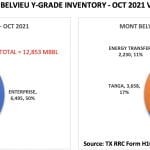
It is probably not a big surprise to most NGL market pundits that Mont Belvieu Y-grade (raw mix) inventories were up sharply last year. As shown on the left-hand chart below, Mont Belvieu Y-grade inventories, as recorded by the Texas Railroad Commission (TX RRC), for October 2021 were 12.8 million barrels. The right-hand chart below shows that Mont Belvieu Y-grade inventories were much higher in October 2022 at 20.9 million barrels, an increase of 63%. By far the largest build in Y-grade volumes was at Enterprise storage where stocks more than doubled to 14.2 million barrels.
Featured Articles


- Blog
Hotel Fractionation - Far-Reaching Impact of the Unprecedented Shortfall in NGL Fractionation Capacity
Y-grade, welcome to the Hotel Fractionation. You can check in any time you like, but you can never leave! OK, so that’s a bit of an overstatement. But there is no doubt that the U.S. NGL market has entered a period of disruption unlike anything seen in recent memory. Mont Belvieu fractionation capacity is, for all intents and purposes, maxed out. Production of purity NGL products is constrained to what can be fractionated, and with ethane demand ramping up alongside new petchem plants coming online, ethane prices are soaring. But that’s only a symptom of the problem. Production of y-grade — that mix of NGLs produced from gas processing plants — continues to increase in the Permian and around the country. Sooo … If you can’t fractionate any more y-grade, what happens to those incremental y-grade barrels being produced? How much can the industry sock away in underground storage caverns? Does it make economic sense to put large volumes of y-grade into storage if it will be years before it can be withdrawn? — i.e., “you can never leave.” And what happens if y-grade storage capacity fills up? Today, we begin a blog series to consider these issues and how they might impact not only NGL markets, but the markets for natural gas and crude oil as well.


- Blog
A Perfect Storm – Polar Vortex Turns Propane and other NGL Markets Upside Down
Last week the U.S. NGL markets entered uncharted territory. According to OPIS, cash propane prices in the Conway, KS market reached almost $5.00/gallon for a time, responding to a massive product shortage across the entire eastern half of the country. But at the same NGL hub, OPIS also reported that the price for ethane/propane mix (EP mix) dropped deep into negative territory at $(0.50)/gallon. That’s crazy. The seller is paying the buyer to take the product. Nothing like this has been seen before in these markets. Propane inventories continue to drop, transport trucks are moving product hundreds of miles to markets, terminals remain on allocation and a state of emergency has been declared by at least 20 state governors. The inventory graphs look so scary that the Black Swan is frozen stiff. Today we begin a series on the NGL markets of 2014, a year that this industry will be talking about for a long time.


- Blog
Basket Case - The Strange Relationship Between Mont Belvieu and Conway NGLs
Mont Belvieu, TX and Conway, KS, are the two most significant U.S. hubs for NGL trading, storage and fractionation, with the much bigger Mont Belvieu hub primarily serving Gulf Coast and export demand, while the smaller Conway hub is focused on Midwest/Great Plains demand, especially for propane. The pricing dynamics between the two hubs are a key indicator of the supply/demand balance between the regions, but they don’t have the same kind of influence over the direction or magnitude of flows as price differential dynamics often do for other energy commodities. In today’s RBN blog, we will examine the gap between the price of the NGL “basket” in Mont Belvieu versus Conway and what that price spread tells us.
