


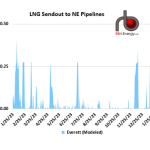
Over the 10-day period from January 14 to January 23 the Everett LNG import facility in Massachusetts provided 2.4 Bcf in total natural gas to the Northeast pipeline market (or 0.24 Bcf/d on average). This is equal to the amount of gas sendout from Everett over a comparable period in mid-December and larger than the amount for any other 10-day period since 2022. While the amount of gas Everett provides to the market is tiny relative to overall Northeast demand that can exceed 35 Bcf/d, the gas is available during the coldest days of the year and arrives in capacity constrained Metro Boston.
Featured Articles


- Blog
Hello, Goodbye - New England Hopes New Life for Everett LNG Will Help Ease Reliability Concerns, Despite Mystic's Closure
The 1,413-MW Mystic Generating Station, a longtime workhorse for New England, shut its doors for good May 31. Located in Charlestown, MA, on the north side of Boston, Mystic is adjacent to the Everett LNG terminal, which supplied 100% of Mystic’s natural gas for several decades. The power plant’s closure meant the Everett terminal might also be history. However, the Massachusetts Department of Public Utilities (DPU) recently approved new contracts that will keep Everett LNG open for at least six more years. In today’s RBN blog, we’ll discuss the combined impact of Mystic’s demise and Everett’s stay of execution, how the region has handled this summer’s heat wave, and what could be in store for next winter.


- Blog
Cold As Ice - Pending Closure of Everett LNG Terminal Poses Challenge for New England Gas Supply
The Everett LNG import terminal, a mainstay of Boston’s gas grid, is expected to close by the end of May 2024, raising questions about future gas supply in New England. The terminal’s closure is closely tied to the imminent loss of its biggest customer, the 1,413-MW Mystic generating station — the region’s largest fossil-fuel plant. Constellation Energy, which owns both the Everett terminal and the Mystic power plant, has said it can’t keep Everett open next year when the Mystic plant closes unless another gas purchaser takes its place. In today’s RBN blog, we’ll address the impacts of Everett’s potential demise on New England in the short term and on regional gas supply during future polar vortex events.


- Blog
I Need You - Gas Pipeline-Constrained New England Keeps Lifelines to Fuel Oil and LNG
It’s so ironic. New England is only a stone’s throw from the burgeoning Marcellus natural gas production area, but pipeline constraints during high-demand periods in the wintertime leave power generators in the six-state region gasping for more gas. Now, with only minimal expansions to New England’s gas pipeline network on the horizon, the region is doubling down on a long-term plan to rely on a combination of gas liquefaction, LNG storage, LNG imports and gas-to-oil fuel switching at dual-fuel power plants to help keep the heat and lights on through those inevitable cold snaps. Today, we discuss recent developments on the gas-supply front in “Patriots Nation.”
