


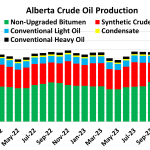
Data from the Alberta Energy Regulator (AER) indicates that Alberta’s oil production fell 380 Mb/d in January to 3.81 MMb/d (rightmost stacked bars in chart below). The pullback was seen across all categories of production as an intense cold snap in mid-January slowed operations, especially for oil sands output such as bitumen mining and upgrading to synthetic crude oil. Despite the drop, production was a record for the month of January, exceeding the year ago prior record of 3.74 MMb/d.
Featured Articles
- Analyst Insight
Alberta Crude Oil Production Recovers in February, But Still Below 2023 Highs
Alberta's oil output recovered in February after the downturn caused January's intense cold. Current output is still below the records seen at the end of 2023. With expansions underway, new production records should be on tap in the second half of this year.
- Analyst Insight
Alberta Sets New Crude Oil Production Record for July; Year-on-Year Growth Decelerates
Alberta's oil output recovered to 4 MMb/d in July, led by gains in synthetic crude oil;. With turnarounds complete in the oil sands, August crude production might possibly set an all-time record north of 4.2 MMb/d.


- Blog
Rock Bottom, Part 2 - Will Record-Low WCS Prices Spur Oil Sands Producers to Reduce Output?
The crash in global crude oil markets has meant low prices for all producers, but no place more so than in Alberta’s oil sands. Transportation, blending and quality differentials mean that benchmark Western Canadian Select (WCS) is priced at a significant discount to light, sweet West Texas Intermediate. With WTI prices seemingly stuck below $30/bbl, the absolute price of WCS last week tumbled to all-time lows below $5/bbl. If they persist, will WCS prices south of $10/bbl generate wide-scale production shut-ins in the oil sands? Today, we continue our series on the challenges facing Alberta’s oil sands.
