
U.S. Gulf Coast (USGC) crude exports plummeted to 3.1 MMb/d (far right of chart below) for the week ended November 13. According to our Crude Voyager report, this is the lowest weekly volume since early August. Houston volumes reached their lowest level since July 2025, and Corpus Christi exports fell 10%, dropping below 2.1 MMb/d. For the first week since RBN’s records began in 2018, zero Very Large Crude Carriers (VLCCs) were seen entering the Gulf Coast. Since inbound VLCCs can indicate near-term demand for U.S. crude from Asian buyers, the zero count may point to a pause in that segment of export demand. No reverse-lightering operations were recorded either, compared with two or three in recent weeks.
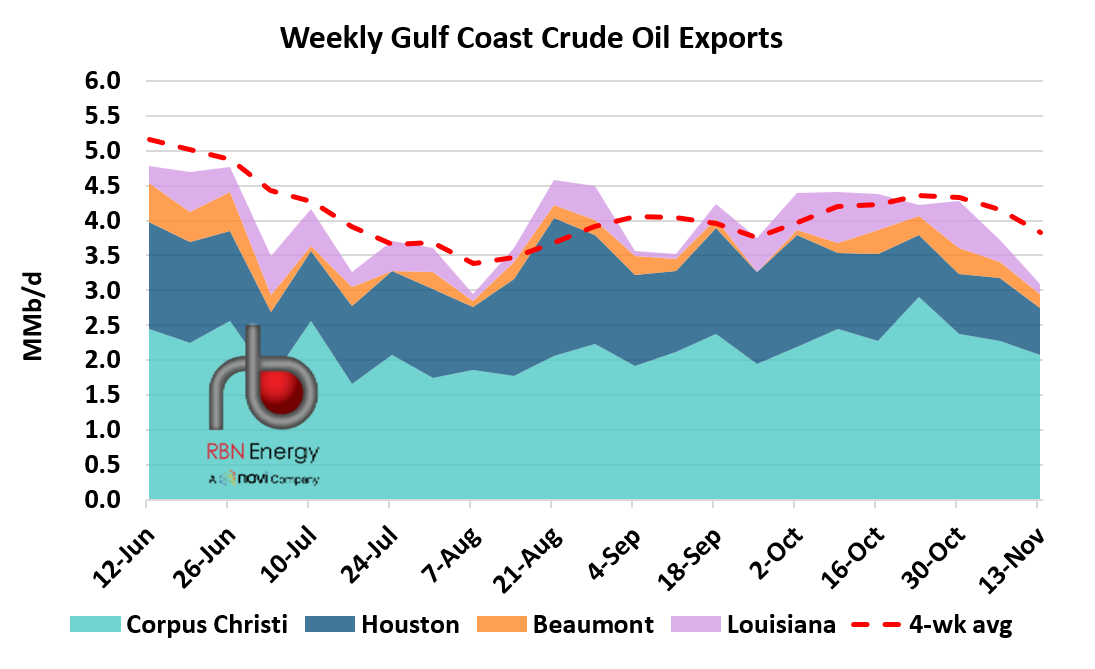
The zero-arrival count does not mean Asian-bound exports stopped, smaller tankers still carried cargoes to South Korea and Thailand. Only one VLCC participated in loading operations this week. The VLCC Hou-Ei partially loaded at the South Texas Gateway Terminal in Corpus Christi before sailing to the Louisiana Offshore Oil Port (LOOP) to complete loading operations. VLCC freight to Asia also fell 40% to about $32 million, lowering the cost of shipping U.S. crude. Even with USGC-to-Asia VLCC freight down sharply from its October highs, U.S. crude remains uncompetitive in Asia, as the narrower Brent-WTI spread has more than offset the freight savings and Asian refiners are favoring Middle Eastern barrels, which are now moving more steadily through Hormuz on a voyage several weeks shorter. With exports at a 14-week low and global supply expectations improving, buyers may have less incentive to arrange long-haul USGC cargoes. A rebound in VLCC arrivals and lightering would help show whether this was a temporary lull or a more persistent pullback.