


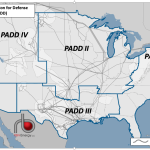
The Petroleum Administration for Defense Districts (PADD) are an integral part of the United States energy infrastructure, responsible for overseeing and coordinating energy production, distribution, and conservation in the United States. Established in World War II in response to the critical shortage of petroleum products, the PADDs have evolved over the years to become the most important energy policy and planning region in the country. In this article, we will explore the history of the PADDs and the role they play in the U.S. energy landscape. At the outset the Petroleum Administration for Defense Districts (PADD) was created in 1941 in response to a increasing demand for petroleum products due to the U.S. involvement in World War II. The PADDs were established to manage the distribution of oil within the United States, as well as to conserve resources. The original five PADDs were the East Coast PADD (I), the Midwest PADD (II), the Southwest PADD (II), the Rocky Mountains PADD IV), and the West Coast PADD (V).
Featured Articles


I Left My (Crude) In San Francisco - What is Driving PADD 5's Increased Reliance on Imported Crude?
The West Coast energy market, PADD 5, is undergoing a profound transformation. Consumption of petroleum-based refined products is declining due to a host of factors including increased renewable diesel (RD) usage, slowing population growth, electric vehicle (EV) penetration and fuel efficiency improvements, just to name a few, but that’s only half the story. Further upping the stakes, crude oil production in the region has declined faster than downstream consumption, so it has had to increasingly rely on imported barrels to support its dwindling refinery throughput. In today’s RBN blog, we look at how the West Coast’s supply of refined products and crude oil has evolved over time and why its reliance on imports has grown.


Pictures of You - Regional Balances Tell the Tale of the U.S. Crude Oil Market
Over the past 15 years, the U.S.’s crude oil supply/demand balance has been transformed by the Shale Revolution. Increasing production unlocked through horizontal drilling and hydraulic fracturing have pushed up the nation’s overall supply without an equal change in refining capacity, resulting in significant changes in regional balances. In today’s RBN blog, we discuss what PADD-by-PADD crude oil supply/demand balances can tell us and preview our latest Drill Down Report.


Rocky Mountain High – PADD IV Refining Economics Gain Altitude
No, we aren’t talking about Colorado’s recent legalization of the “wacky weed”, but rather the high that the rush of light crudes is bringing to the refining industry in PADD IV, the Rockies region. While John Denver’s famous lyrics spoke of the magic of the Rocky Mountains, regional refiners have found elation in recent years as both domestic and readily accessible Western Canadian production increased, stranding crude supplies, putting downward pressure on prices and lifting their margins sky high. Today we examine how this has impacted the economics of the region and incentivized investment.
