


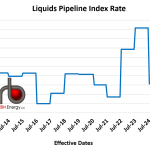
Effective July 1, 2025, oil and liquids pipelines that are regulated by the Federal Energy Regulatory Commission (FERC) and charging “index” rates will be able to increase their rates by just under 2%. Index rates are the most popular form of pipeline ratemaking for interstate oil and liquids pipelines. In September 2024, FERC issued an order reinstating the oil pipeline index level to use for the five-year period commencing July 1, 2021 to Producer Price Index for Finished Goods (PPI-FG) plus 0.78% (prior to the revision it was PPI-FG minus 0.21%). This year’s adjustment results in a positive index factor of 0.019976, meaning oil pipelines are required to multiply their July 1, 2024 through June 30, 2025 index ceiling levels by 1.019976 to compute their index ceiling levels for July 1, 2025 through June 30, 2026.
Featured Articles
FERC Oil & Liquids Pipeline Index Rates Take a Breather


You Really Got Me - FERC Crude Oil Pipeline Tariffs Jump Again, With Differing Impacts on Customers
When the calendar flipped from June to July, it did more than just close the book on the first half of 2023, it also allowed some oil pipelines regulated by the Federal Energy Regulatory Commission (FERC) to increase their rates by more than 13%. Yes, you read that correctly. This is the largest increase in the index rate since FERC initiated its current methodology in 1992 and follows last year’s increase of almost 9%. In today’s RBN blog, we look at what’s going on with index rates at FERC and what it means for producers and shippers alike.


Now Here You Go Again - FERC Prepares to Slash the Liquids Pipeline Rate Index
On Thursday, June 18, the Federal Energy Regulatory Commission (FERC) issued a Notice of Inquiry (NOI) to reset the index that’s used to make annual changes to the rate ceilings for interstate pipelines that transport crude oil, refined products, and other hydrocarbon liquids. Every year, the highest rate an indexed oil pipeline can charge goes up or down — almost always up — using the FERC index. The commission’s new proposal, which would become effective in July 2021, follows an already-approved index adjustment that will take effect a week from Wednesday, on July 1. Taken together, the two changes would reduce the maximum annual increase in the rate ceiling from more than 4% now to less than 1%, which could have a major impact on liquids pipeline owners. Today, we discuss the NOI, the meaning of the pipeline index, where it came from, and where it might be headed.
