


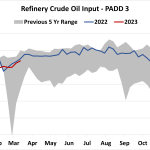
Net refinery input was down a mere 20 Mb/d, at 15.4 MMb/d last week. Gross refinery input was up by 60 Mb/d to 16 MMb/d, which brought capacity utilization up by 0.3 percentage point to 88.6%. PADD 2 input was down 150 Mb/d and PADD 1 was down 100 Mb/d. Input in PADD 3 was up 200 Mb/d last week and may be due to Exxon’s Beaumont refinery coming online. It was announced that Exxon has successfully started up the new $2-billion crude distillation unit, which adds 250 Mb/d to the refinery's capacity, increasing it to more than 630 Mb/d. The new expansion is now running successfully and Exxon is aiming to reach full capacity of by the end of March.
Featured Articles


- Blog
Big Time - Permian Majors Expand Downstream Crude Refining Capacity
In the past month, two integrated majors with strong footprints in the Permian Basin announced plans to increase their refining capacity along the Texas Gulf Coast. During the last week of January 2019, ExxonMobil announced a final investment decision to expand its Beaumont, TX, facility’s capacity by 250 Mb/d, making it the largest U.S. refinery, and then confirmed an investment with Plains All American and Lotus Midstream to build a 1-MMb/d pipeline to ship crude to its Beaumont and Baytown, TX, refineries. In the same week, Chevron announced its purchase of the 110-Mb/d Pasadena, TX, Houston Ship Channel refinery from Brazil’s national oil company, Petrobras. Both Exxon and Chevron boasted record Permian production in their fourth quarter 2018 earnings calls. Today, we review Chevron’s purchase and Exxon’s expansion in light of Permian production growth and the changing Gulf Coast refining market.


- Blog
Beaumont-ian Rhapsody? Exxon's Gulf Coast Refinery Investments Underpin U.S. Expansion
ExxonMobil earlier this month told analysts in New York that the company expects to add a total of 400 Mb/d of capacity to its three giant Gulf Coast refineries by 2025. Exxon plans to upgrade existing refineries in Houston (Baytown) and Baton Rouge, LA, to increase production of higher-value products and to add a new crude distillation unit to its 362-Mb/d Beaumont, TX, plant after 2020. A final investment decision on the Beaumont expansion — which reportedly would double the refinery’s throughput capacity and make it the largest refinery in the U.S. — is expected later this year and follows a $6 billion investment by Exxon to triple crude output from its Permian Basin production assets in West Texas. Today, we discuss the existing Beaumont operation, its feedstock sources, and the refined-product demand that supports the plant’s expansion.


- Blog
Take Me to the Top - Will Another Big-Money Deal Take ExxonMobil to #1 in the Permian?
For a major oil and gas producer, organic growth over time is all well and good. But if you want next-level scale — and the economies that come with it — there’s nothing like cannon-balling into the deep end of the pool with a huge, game-changing acquisition. ExxonMobil has already done that twice — first in 2010 with the $41 billion purchase of XTO Energy, then in 2017 when it bought the Bass family’s oil and gas assets for $6.6 billion. Now it’s said to be poised for another big plunge, and to be eyeing the Permian’s largest E&P, Pioneer Natural Resources. In today’s RBN blog, we analyze a potential deal that would make Exxon the dominant producer in the premier U.S. shale play.
