


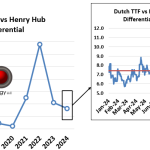
The arbitrage between Dutch TTF (Title Transfer Facility, the European marker hub price) and Henry Hub reached its highest level in more than a year over the last few days. The price of natural gas at Henry Hub settled at $2.35/MMbtu on Tuesday while TTF posted 42.87/EUR/Mwh, which converts to $13.75/MMbtu. The difference is 13.75 - 2.35 = 11.40, as shown in the purple dashed circle, right graph below. Note that this level remains well below the wide differential experienced in 2022 (annualized differential, left graph).
Featured Articles

- Blog
Hazy Shade of Winter - European Gas Markets Avoided Mayhem This Winter, But Challenges Remain
Russia’s invasion of Ukraine in February 2022 caused panic in European gas markets that were already on the brink due to low winter inventories. Near-term supply/demand balances suddenly took on a heightened urgency, and everyone knew that policy and infrastructure changes were needed, pronto. The most immediate concern was the very real possibility that the winter of 2022-23 could see gas rationing within the European Union (EU) due to supply shortages. However, with winter now in retreat, Europe is emerging with record volumes of stored gas accompanied by prices that have fallen to pre-invasion levels. This is no time for complacency, though. While it’s many months away, the winter of 2023-24 looms, with dire warnings that things could be considerably worse in gas markets. In today’s RBN blog, we evaluate how European gas and LNG markets have managed over the last 12 months and discuss the implications for the next year. In particular, we look at the European Commission’s (EC) efforts to inject reforms into European gas markets, not only to accommodate supply disruptions but also to set the stage for a gas market no longer reliant on Russian supplies.


- Blog
Where Do We Go From Here? - Assessing Next Steps After Russia Cuts Gas to Poland and Bulgaria
It’s been more than two months since Russia invaded Ukraine, sending global energy markets into chaos as most of Europe tries to figure out a way to quickly reduce its reliance on Russian supplies. The initial response from the U.S. and its allies was a slate of economic sanctions, but those largely left natural gas out of the equation, as parts of Europe are so dependent on Russian gas that stopping the flows would pose serious threats to the continent’s economies and energy security. Now, with no sign of an end to military hostilities and continual increases in the scope of sanctions, Russia is responding by starting to shut off flows to European countries that refuse to pay for their gas in rubles. Where is this headed? In today’s RBN blog, we look at the latest escalation, what led to this point and where the market might go from here.
- Analyst Insight
European Natural Gas Price Headed Higher, Widening Spread to Henry Hub
After languishing during most of 2024, Dutch TTF has spiked in the past week.
