


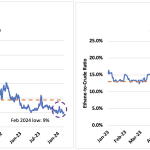
As shown on the left-hand chart below, ethane’s price relative to crude oil (WTI Cushing) has plunged recently, hitting a low of 9% on February 16. This marks the lowest level the ratio has been since hitting 7.2% in late July 2019. As shown on the right-hand chart below, the ethane-to-crude ratio was relatively stable for most of 2023, averaging 13.3%, but weakened to an average of 10.5% so far this year.
Featured Articles


- Blog
Fly Me to the Moon - Ethane Prices Rocket into Space, then Crash to Earth on Tuesday. What Happened?
In just over a month, the price of Mont Belvieu purity ethane doubled, from 19 c/gal to 39 c/gal on Friday. Sure, the price of natural gas was up about 15% over the same period. But that increase was nowhere near ethane’s, so it was certainly not the price of gas that was making ethane take off. In fact, with ethane rocketing into space and gas prices still in the dumper, the ethane-to-gas ratio — a key measure of the value of ethane — skyrocketed, soaring from 1.2X in mid-June to 2.2X on Friday. A ratio at this level has only happened twice before in the past decade: once in 2018 due to a collision between fractionation capacity and new petchem plants coming online, and then again in 2020 during the COVID petchem demand surge. But the most recent price surge didn’t last long. On Tuesday ethane came back to earth, crashing 22% in a single day, and the ethane-to-gas ratio deflated down to 1.6X. So what’s happening? There are a lot of conspiracy theories out there that we won’t repeat here. Instead, in today’s RBN blog, we’ll lay out what we think are the most likely contributing factors behind this wild ride.


- Blog
Ethane Asylum Revisited - New U.S. Cracker Demand, Exports Will Strain Ethane Supply
The last couple of years have been a wild ride for the U.S. ethane market, but look out ahead. It’s going to get crazy. The onslaught of new, ethane-only crackers is upon us at the same time overseas exports are expected to ramp up. At first glance, it might appear there is enough ethane to meet all that demand, coming from molecules that today are being rejected — that is, sold as natural gas rather than liquid ethane. But the big question — will it be enough? Because not all that rejected ethane has access to pipeline capacity needed to get it to market, at least not right now. In today's blog, we begin a new series on rising ethane demand, how the new demand will be met, and what it all means for ethane prices.


- Blog
EBITDA-To-Interest Ratio
<p>(Note: Each column is sortable by clicking once or twice on the column title. For example, clicking on "Total" will
rank the companies either low-to-high or high-to-low.)</p>
