


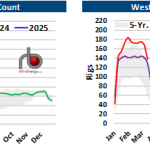
For the week ending March 14, Baker Hughes reported that the Western Canadian gas-directed rig count fell four to 60 (blue line and text in left hand chart below), 19 less than one year ago and the lowest since the start of the year. The oil-directed rig count pulled back 31 to 137 (red line and text in right hand chart), nine more than a year ago, nine greater than the top of the five-year range, and its lowest value since the start of the year. The pullback in both rig counts now clearly points to the onset of spring break up, a time of year when drilling and rig movement activity is reduced as a result of restrictions on the movement of heavy equipment in some regions due to the thawing of ground conditions. Weather in Western Canada has been mild, with the first two weeks of March in northeast British Columbia (BC) being the warmest since 2021 and 15% warmer than the 30-year average; conditions in northwest Alberta are the warmest since 2015 and 24% warmer than the 30-year average, while in the Alberta oil sands region, conditions have been the warmest since 2018 and 8% warmer than the 30-year average.
Featured Articles
- Analyst Insight
Canadian Drilling – Rig Counts Head Lower, Early Arrival of Spring Break Up?
Spring break up might arriving or two weeks earlier than usual as gas and oil rig counts dropped this past week.
- Analyst Insight
Canadian Drilling – Oil Rig Counts Sink Further as Spring Break Up Takes Full Hold
Spring break up remains in high gear with the oil rig count plunging an additional 21 rigs in the latest week.
- Analyst Insight
Canadian Drilling – Rig Counts Remain Soft at the Midpoint of Spring Break Up
Canadian rig counts remain soft at the midpoint of spring break up. Latest oil price crash will not help!
