The natural gas futures contract for the prompt month barreled a net ~$1.00 (26%) higher in the past 12 days as the potential for prolonged production shut-ins in the Gulf of Mexico after Hurricane Ida amplified already-heightened supply fears in both the U.S. and international gas markets. The blistering price action sent the CME/NYMEX Henry Hub October futures contract soaring on Wednesday to an intraday high above $5/MMBtu and a settle of $4.914/MMBtu, the highest during September trading since 2008, while the prompt December and January contracts settled above $5/MMBtu for the first time in years. Prices at European and Asian gas/LNG hubs have similarly rallied this summer to multi-year or even all-time highs. Offshore Gulf gas production has since begun to recover, slowly, after the Ida-damaged Port Fourchon in Louisiana, the base of offshore oil and gas operations, reopened over the Labor Day weekend, but the bulk of it remains offline as power outages and other operational challenges persist. The shut-ins are exacerbating an already tight market, marked by record LNG exports, lackadaisical production growth, and a growing inventory deficit compared with year-ago and five-year average levels. Those underlying fundamentals will remain a trigger point for price spikes well after Ida-related shut-ins recover. Today, we discuss where the gas market stands heading into the final months of the injection season and the implications for winter gas pricing.
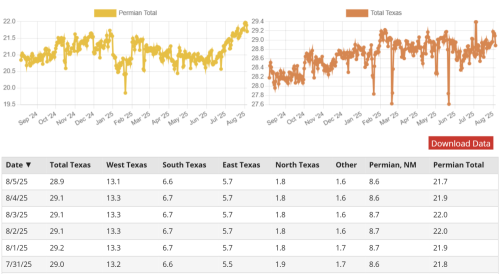
The NATGAS Production Tracker - Texas provides a DAILY update of natural gas production in Texas the New Mexico side of the Permian Basin. Quickly and easily view today’s supplies in the Lone Star state and download the full historical table when you need it.
One of the many side effects of the Shale Revolution was that it altogether changed how hurricanes affect the Lower 48 gas market. The emergence of vast volumes of onshore gas supplies from shale drilling turned what used to be predominantly price-supportive events that disproportionately curtailed supply from the Gulf of Mexico, into net bearish events with a bigger negative impact on Gulf Coast industrial and power demand than on supply. That dynamic has been magnified in recent years with the rapid rise in LNG exports from Gulf Coast terminals, which have significantly increased gas demand along the Texas and Louisiana coasts. Offshore production is now less than 3% of total Lower 48 dry gas production, but feedgas deliveries to the LNG export facilities now make up over 10% of Lower 48 demand, and for the most part that demand is concentrated along the Gulf Coast. So, a direct hit from major storms to the export facilities can intensify, and even prolong, a storm’s destructive effect on gas demand. We saw this last summer when back-to-back hurricanes, Laura and Marco (dashed yellow and red ovals in Figure 1), took the Sabine Pass and Cameron LNG terminals offline and kept feedgas demand (orange line) down even after offshore production (navy blue area) recovered.
On the other hand, with an increasing proportion of offshore production going to serve LNG demand, storms that cause protracted production shut-ins in the Gulf of Mexico but minimal impact on exports can do the opposite — magnify the effect of the supply loss on the Gulf Coast market, as we saw with Ida last week (dashed green oval in Figure 1). Add to that the bullish pre-existing conditions this year of a significant and growing storage deficit vs. prior years, as well as stagnant production, a shrinking window of opportunity to refill storage, and more LNG export demand on the way, and the stage is set for the kind of feverish rallies we’ve seen in gas futures in the past couple of weeks.

About the song
"High Voltage" was written by Angus Young, Malcom Young, and Bon Scott. It appears as the fifth song on side two of AC/DC's first internationally released album of the same name. Personnel on the record were: Bon Scott (lead vocals), Angus Young (lead guitar), Malcom Young (rhythm guitar, backing vocals), George Young (bass), and Tony Currenti (drums).
The album, High Voltage, was recorded in 1974-75 at Albert Studios in Sydney, with Harry Vanda and George Young producing. Released in May 1976 in the U.S., the LP went to #3 on the Billboard Top 200 Albums chart. It has been certified 3x Platinum by the Recording Industry Association of America.
AC/DC is a rock and roll band formed in Sydney in 1973 by brothers Malcom and Angus Young. The band went through several personnel changes before releasing its first record in Australia in 1975. The band then included the Young brothers on guitars, vocalist Bon Scott, drummer Phil Rudd, and bassist Mark Evans. Evans was fired from the band in 1977, and replaced by Cliff Williams. Bon Scott died in 1980, and was replaced by Brian Johnson. Malcom Young died in 2017, and was replaced by Stevie Young, Malcom and Angus' cousin. The band has released 17 studio albums, three live albums, two soundtrack albums, one EP, and 48 singles. AC/DC have sold more than 200 million records worldwide. They have received one Grammy Award, and are members of the Rock and Roll Hall of Fame. The band released their latest album, Power Up, in September 2020. The album debuted at #1 on the Billboard Top 200 Albums chart.