


The Gulf Coast region is the biggest refining destination for the flood of new crude oil being produced domestically and in Canada. Large terminals are needed to receive, store, blend and redistribute this crude to refineries. Operators will capture lucrative handling fees as this crude passes through their facilities. Today we continue our survey of Gulf Coast crude oil terminals.
This blog series covers the construction or expansion of crude storage and blending facilities in the Texas and Louisiana Gulf Coast regions. In the first episode (see ECHO and the Blending Men”) we looked at one of the biggest players – Enterprise and their brand new Enterprise Crude Houston (ECHO) terminal. ECHO connects incoming crude from Eagle Ford and Cushing to Houston area refineries and is vying for the chance to be the delivery point should the NYMEX launch a Houston based futures contract. This time we look at one of the region’s largest crude storage facilities at Nederland on the border between Texas and Louisiana.
Nederland Terminal is owned by Sunoco Logistics Partners, LP. Like any modern midstream company, Sunoco Logistics is a Master Limited Partnership (MLP – see Masters of the Midstream) operated by its General Partner Sunoco Partners LLC itself the 100 percent subsidiary of Energy Transfer Partners LP, another MLP. Whatever it takes.
Nederland Terminal is located on the Sabine-Neches waterway between Beaumont and Port Arthur, Texas (see map below). This primo location is right in the heart of Beamont/Port Arthur refining country – home to four large refineries owned by ExxonMobil (Beaumont, 365 Mb/d), Valero (Port Arthur, 310 Mb/d), Total (Port Arthur, 230 Mb/d) and Shell/Saudi Aramco (Motiva in the process of being upgraded to 600 Mb/d). Nederland is also within spitting distance of Spindletop – where crude oil was discovered in Texas back in 1901. The Sabine River connects to the Gulf of Mexico, providing waterborne access to the entire Gulf Coast region. Nederland is about 100 miles East of Houston and 350 miles West of New Orleans.
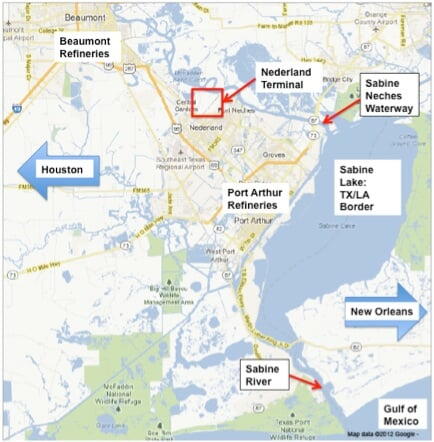
Source: RBN Energy
Nederland is a marine terminal providing storage, blending and distribution services for refiners and crude oil marketers. In addition to crude oil, the facility handles other refinery feedstocks, lubricants, petrochemicals, and bunker oils (used for fueling ships and other marine vessels), and also blends lubricants. The terminal has a storage capacity of approximately 22 MMBbl in about 130 aboveground storage tanks with individual capacities of up to 660 MBbl. Nederland can receive crude oil from ocean going tankers at five ship docks and coastwise barges at three barge berths along the Sabine Neches waterway. The five ship docks are capable of receiving over 2 MMb/d of crude oil. The current rail capabilities at Nederland can offload 30 cars a day – meaning they can handle a unit train in four days. Sunoco is in the process of upgrading the rail capabilities to handle more rail cars. Crude oil arriving by rail can be offloaded into pipelines or onto barges for redelivery throughout the region.
Unlike the brand spanking new ECHO Terminal, Nederland has been around for a hundred years or so since Sun Oil Company first set up a terminal in the early twentieth century. Sitting in the middle of all that crude oil and refining business has given rise to seriously good pipeline connections along the way. For starters, Nederland is connected to the four nearby refineries we mentioned above by pipeline and can therefore provide them with crude oil supplies as well as storage and blending. As part of the recently completed Motiva 325 Mb/d refinery expansion project, Sunoco built 2 MMBbl of crude storage for Shell and a new 30-inch connecting pipeline between Nederland and the refinery. The $10 B Motiva expansion project was delayed for 6 months by damage to the new crude distillation unit but is expected to come back online this week (1st week of December 2012) and increase the refinery capacity to 600 Mb/d.
Existing Pipeline Connections
Nederland connects to ~650 Mb/d of inbound and 400 Mb/d of outbound crude oil pipeline capacity in the Texas Gulf Coast region as follows:
- The 200 Mb/d Shell Houma to Houston “Ho-Ho” pipeline from Louisiana that is in the process of being reversed (see Oh-Ho-Ho It’s Magic). The Ho-Ho reversal links Nederland to Lake Charles refineries and New Orleans area refineries to the East as well as Baytown and Houston refineries to the East (download the Ho-Ho pipeline map from our recent blog series here).
- Nederland is a delivery point on the 350 Mb/d Cameron Highway Oil Pipeline (CHOPS) that delivers Gulf of Mexico crude oil production from the Garden Banks, Cameron, Poseidon and Green Canyon fields. CHOPS is owned by Enterprise Products and Genesis Energy.
- The 96 Mb/d ExxonMobil Pegasus pipeline that runs from Patoka in Illinois to Nederland.
- Two Department of Energy (DOE) pipelines that deliver crude into US Government Strategic Petroleum Reserve Storage at Big Hill and West Hackberry (250 Mb/d capacity each).
- Two Sunoco Logistics crude pipelines (400 Mb/d total capacity) that currently flow to Longview in East Texas (connecting to the Sunoco Mid Valley Pipeline to the upper Midwest) and are both in the process of being reversed to receive crude from the Permian Basin (see expansion pipelines below).
Expansion Pipelines
The Nederland Terminal is the delivery point for 3 new Sunoco Logistics pipeline expansion projects that will deliver crude from the Permian Basin in West Texas. Nederland will also connect with incoming crude flows on the 700 Mb/d TransCanada Keystone Gulf Coast Extension from Cushing, OK. The table below summarizes these projects, their capacities and expected in-service dates. These pipelines will connect just over 1 MMb/d of inbound crude capacity to Nederland for total inbound capacity in 2014 of 1.4 MMb/d and 200 Mb/d outbound (Ho-Ho).







Comments
Sandy --
This is one of my all-time favorite RBN articles. Great info, well presented, and time is proving how much on the money it was.
As good as this article is, the name is even better. Having been to Nederland, the association of Nederland and Wonderland totally cracks me up. I still laugh over it everytime I see the name Nederland.