U.S. crude oil, NGL and gas markets have entered a new era. Exports now dominate the supply/demand equilibrium. These markets simply would not clear at today’s production levels, much less at the flow rates coming over the next few years, if not for access to global markets. This year, the U.S. may export 20-25% of domestic crude production, 15% of natural gas and 40% of NGLs from gas processing, and those percentages will continue to ramp up. What will this massive shift in energy flows mean for U.S. markets, and for that matter, for the rest of the world? The best way to answer that question is to get the major players together under one roof and figure it out. That’s the plan for Energy xPortCon 2019. Warning!: Today’s blog is a blatant advertorial for our upcoming conference.
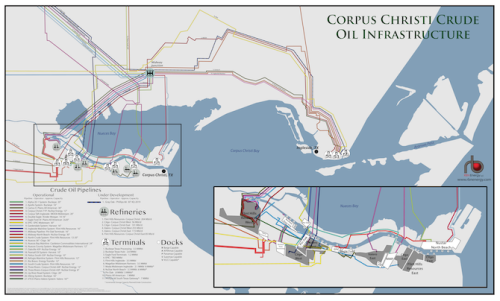
Gain insight and clarity into one of the United States’ most strategic Crude Oil Export Markets with RBN Energy’s Corpus Christi Crude Oil Infrastructure wall map.
Figure 1 shows just how remarkable the growth in exports has been over the past five years. Back in 2014 before the ban on most crude exports was lifted, a paltry 4% of U.S. crude oil production was exported (0.35 MMb/d; blue layer and left axis in leftmost graph), almost all of it to Canada. (The burgundy line and right axis show percentage of total production that is exported.) In striking contrast, for the past three months an average of 20% of U.S. crude production has been exported (2.3 MMb/d), and the number is moving higher. Assuming WTI/Cushing crude prices get back to the mid $60/bbl range, exports could increase to more than 6.0 MMb/d by 2024, which would put exports in the range of 35-40% of total production.
Natural gas exports have also come on strong, from 6% of Lower-48 production in 2014 up to about 12% over the past three months (blue layer and burgundy line in middle graph). Note that this includes gas exports to overseas markets in the form of liquefied natural gas (LNG), plus pipeline exports to Mexico. A big step up in that number will come over the next year or so, with up to 5.0 Bcf/d of new LNG export capacity coming online this year at Cheniere’s Sabine Pass and Corpus Christi facilities, plus Sempra’s Cameron, Kinder Morgan’s Elba Island and the first train at Freeport (For more on LNG export facilities, see our Let Me Move You series).

About the song
"Take It All," written by Adele and Francis "Eg" White, is the seventh track on Adele's multi-platinum second studio album, 21. The song features Adele on lead vocals, accompanied by a piano and choir. "Take It All" was recorded at Sphere Studios in London, and produced by Jim Abbiss. Neil Cowley played the piano on the cut.
Released in the U.S. in February 2011, 21 is a mostly autobiographical collection of songs Adele wrote about the breakup of a relationship. It reached #1 on the Billboard Top 200 Albums chart, and went on to be certified 14 times Platinum by the Recording Industry Association of America. Five singles were released from the album, three of them going to #1 on the charts.
Adele (Adele Laurie Blue Adkins) is an English singer and songwriter. She has won 18 Billboard Music Awards, 15 Grammy Awards, 15 BMI Awards, nine Brit Awards, five American Music Awards, three Ivor Novello Awards, and three MTV Video Music Awards. She has released three studio albums to date, and is currently working on her fourth, with a projected release date of December 2019.