Henry Hub has long been the center of the universe for the Lower 48 natural gas market, but what it represents has changed dramatically since its inception, particularly over the past decade. It has gone from being a benchmark pricing location for a vibrant producing region, to being situated in the fastest-growing demand region and a key hub for wheeling feedgas supply to the proliferating LNG export facilities in Louisiana — all with little change to its infrastructure. As this occurred, the gas price at Henry has gone from being among the lowest in the country to one of the most premium. Physical volumes exchanged at the hub, which have always been dwarfed by financial trades there (and still are), have climbed in recent years and are now at the highest levels since 2008. Moreover, the inflows are concentrated on just a couple of pipelines, and those key interconnects are at risk of becoming constrained. In today’s RBN blog, we provide an update on the shifting gas flows at Henry Hub.
The last time physical flows at Henry Hub were this high, in the 2008-09 time frame, Gulf of Mexico offshore natural gas production was well over 6 Bcf/d; the Haynesville Shale in western Louisiana was still in its early stages of growth and volumes had just started to take off; the Marcellus Shale in Appalachia was still in its infancy; and all the offshore and onshore supply converging on the pipeline network in Louisiana, including Henry Hub, was flowing northbound to serve the gas-thirsty Northeast markets. Now, offshore production is less than half of what it was then, but Haynesville production hit a record 13.4 Bcf/d in September, according to the Energy Information Administration’s Drilling Productivity Report (DPR). The same pipelines that used to flow north now bring 3-5 Bcf/d of Marcellus/Utica gas supply into Louisiana, mostly via Perryville Hub in northeastern Louisiana — and, yes, Henry Hub in the southeast — to meet growing demand along the Gulf Coast, primarily feedgas for LNG exports.
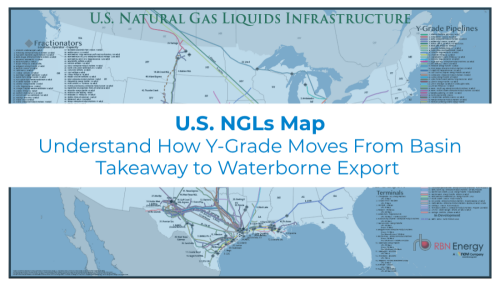
Visualize the infrastructure behind U.S. NGL movement.
The U.S. NGLs Map provides a comprehensive view of the transport, processing, and export networks moving NGLs across the U.S.
The Henry Hub pricing location in Vermilion Parish, LA, has been used as the basis for domestic gas deals for decades and is the delivery mechanism for the third-largest commodity futures trading instrument in the world — the CME/NYMEX Henry Hub natural gas futures contract (behind only WTI and Brent crude). In recent years, it also served as the benchmark for the first wave of U.S. LNG export contracts. (We delved into the formation, evolution, and rationale for the benchmark trading location in our Henry the Hub, I Am I Am blog series, and we highly recommend you revisit those blogs to learn how the hub works.) But the physical infrastructure at the hub has changed little over the decades, and, despite its industry benchmark status and highly liquid futures contract, physical gas flows utilizing those assets were not the driving force there. In fact, physical trade volumes at Henry historically were driven less by physical flows and more by Intra-Hub Transfers (IHT), a “behind-the-scenes” accounting mechanism that gives counterparties the ability to exchange gas there through title transfers, without any physical movement of gas.
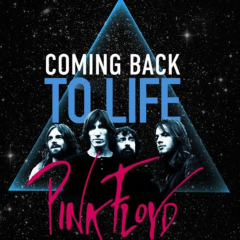
About the song
“Coming Back to Life” was written by David Gilmour and appears as the eighth song on Pink Floyd’s 14th studio album, The Division Bell. Gilmour has said that the song was about his wife, author Polly Samson. It is the only song from the album to be credited solely to Gilmour. Personnel on the record were: David Gilmour (vocals, guitar), Richard Wright (synthesizers, organ), Nick Mason (drums), Guy Pratt (bass), and Gary Wallis (percussion).
The Division Bell was recorded between January and December 1993 at Britannia Row, Astoria, Abbey Road and Metropolis in London, with production handled by Bob Ezrin and Gilmour. Released in March 1994, the album went to #1 on the Billboard Top 200 Albums chart. It has been certified 3x Platinum by the Recording Industry Association of America. Two singles were released from the LP.
Pink Floyd was an English rock band formed in London in 1964 by Syd Barrett, Nick Mason, Roger Waters, Richard Wright and Bob Klose. Six people have passed through the band from its inception until its official breakup in 1994. The band reunited for a one-off benefit concert in 2005 and an appearance at a Syd Barrett tribute concert in 2007. Syd Barrett died in 2006 and Richard Wright in 2008. Drummer Nick Mason is the only Pink Floyd member who was there from the start of the band until the end. The band has released 15 studio albums, four live albums, nine compilation albums, six EPs and 27 singles. They have sold more than 250 million records worldwide. They are members of the Rock & Roll Hall of Fame and the UK Music Hall of Fame. Gilmour, Waters and Mason have separate careers and continue to record and tour as solo artists.