


Two new 50-Mb/d, Kinder Morgan-owned and -operated condensate splitters came online during the first seven months of 2015, backed by a 10-year BP commitment to process a total of 84 Mb/d through the units. Located in the Houston Ship Channel’s refinery row, the splitters were expected to provide a profitable outlet to process growing volumes of the ultra-light crude oil known as condensate. Instead, average plant throughput through July 2016 has been only 71% of capacity, well below the 90% average operating level of neighboring refineries. The relatively low level at which these units have been operating reflects sagging condensate processing margins. Today, we detail how Kinder Morgan’s new splitters have been run during their first year or so of operation.
This blog follows the recent Shooting Star post reviewing the impact of falling production on waterborne movements of the superlight crude known as condensate. As noted in that blog, there has been a drop-off in condensate export volumes—as tallied by our friends at ClipperData—and changes in the international and domestic destinations of condensate moved over water in 2016. Recent changes in condensate movements reflect broader trends in condensate production, which has declined significantly in the face of lower crude prices and narrowing differentials between condensate and “regular” light sweet crudes such as the Gulf Coast benchmark, Light Louisiana Sweet (LLS). We explored these themes in Part 1 of our Faded Love series on condensates, where we looked at the impact of lower prices on condensate production and infrastructure in the Eagle Ford, and in Part 2, where we considered detailed condensate production data from the newly enhanced Energy Information Administration (EIA) EIA-914 dataset. Today’s post (based on a recent note published by Morningstar Commodities and Energy Research) zooms in on the fate of condensate splitters on the Gulf Coast, a few of which are up and running and a few more of which are due online in the next year or two. In particular, we look at the Kinder Morgan-operated splitters along the Houston Ship Channel that came online between March and July 2015.
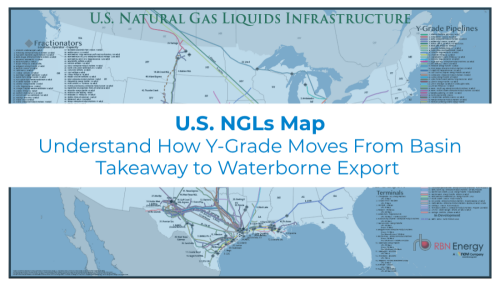
Visualize the infrastructure behind U.S. NGL movement.
The U.S. NGLs Map provides a comprehensive view of the transport, processing, and export networks moving NGLs across the U.S.
In our previous posts on the topic (see the Dancing in The Dark and Whole Lotta Splittin’ Going On series) we described a condensate splitter as a simple refinery that uses atmospheric distillation to separate the feedstock into its component fractions (more on the operations in a minute). The Kinder Morgan splitter is located at the company’s Galena Park terminal, close to the Houston Ship Channel. The project was first announced in July 2012 and later expanded from one 50-Mb/d unit to two, ultimately both backed by a 10-year, 84 Mb/d minimum volume throughput commitment from BP. As of July 2016, Kinder estimated the cost of the splitters—as well as 2 MMbbl of associated condensate and refined-product storage—to be $485 million. The first 50-Mb/d unit came online about a year later than planned, in March 2015, and the second unit followed in July 2015. The splitter’s feedstock supply is delivered to the plant via a lateral to Kinder Morgan’s Crude and Condensate pipeline, known as KMCC. The KMCC came online in June 2012, delivering up to 300 Mb/d from DeWitt County in the South Texas Eagle Ford Basin into the Houston area. The initial 250-mile pipeline has been extended since 2012 to connect with the Kinder Morgan/Magellan Midstream joint venture Double Eagle pipeline, which originates in La Salle County, TX, at Gardendale. Data reported by Kinder Morgan to the Texas Railroad Commission (TRRC), which regulates the Lone Star State’s oil and gas industry, provides insight into the units’ first year-plus of operation.

About the song
“Rock and a Hard Place” was written by Mick Jagger and Keith Richards and appears as the first song on side two of The Rolling Stones’ 21st American studio album, Steel Wheels. Released as the second single from the album in October 1989 and backed with the non-LP track “Cook Cook Blues,” it went to #23 on the Billboard Hot 100 Singles chart. Personnel on the record were: Mick Jagger (lead vocals, guitar), Keith Richards, Ron Wood (guitar), Bill Wyman (bass), Charlie Watts (drums), Matt Clifford, Chuck Leavell (keyboards), The Kick Horns (horns), and Lisa Fischer, Sarah Dash, Bernard Fowler (backing vocals).
Steel Wheels was recorded between March-May 1989 at AIR in Monserrat and mixed at Olympic in London and The Palace of Ben Abbou in Tangier, Morocco. Production was handled by Chris Kimsey and The Glimmer Twins (Jagger and Richards). Hailed as a comeback album upon its release, it marked the patching up of the working relationship between Jagger and Richards, who had been at odds with each other for a few years prior. It also marked the launching of The Rolling Stones’ largest world tour to date, the Steel Wheels Tour. The album was released in August 1989 and went to #3 on the Billboard 200 Albums chart. It has been certified 2x Platinum by the Recording Industry Association of America. Four singles were released from the LP.
The Rolling Stones are an English rock band formed in London in 1962. Eight members have passed through the band since its formation. Founding member Brian Jones died in July 1969, and Charlie Watts in August 2021. Original bassist Bill Wyman retired from the band in 1993. Original members Mick Jagger and Keith Richards, along with long-time guitarist Ron Wood continue to record and tour as The Rolling Stones today. They have released 31 studio albums, 13 live albums, 28 compilation albums, three EPs, and 122 singles. They have won four Grammy Awards, three MTV Video Music Awards, one World Music Award, and are members of the Rock and Roll Hall of Fame. The band released their latest album, Hackney Diamonds, in October 2023.







Comments
KM data from 2013 says the splitters were planned on having the following products:
Yields Six Products:
Y-Grade
Light Naphtha
Heavy Naphtha
Kerosene
Diesel
Atmospheric Gas Oil