


A big build-out of Jones Act product tankers and large ocean-going barges is well under way, just as the future demand for these vessels is coming into question. Within the next 18 months, a total of 17 Jones Act product tankers and large ocean-going articulated tug barges (ATBs) with a combined capacity of more than 4.5 million barrels (MMbbl) will be delivered, boosting the total fleet capacity of these types of vessels by 20%. These new-vessel orders were made a few years ago in response to increased shipments of crude oil within the U.S. that, at the time, had resulted in a shortage of Jones Act product tankers and large ATBs. This in turn led to higher charter rates and the resulting increased costs of shipping crude oil and petroleum products in the coastwise trade. Now though, the decline in U.S. crude oil production has upended expectations. Today, we begin a series on the impact of hydrocarbon market changes on the Jones Act fleet.
Section 27 of the Merchant Marine Act, 1920, commonly referred to as “the Jones Act” is a 96-year-old federal statute that requires that all merchandise transported by water between U.S. ports be carried in U.S.-flagged vessels that are constructed in the United States, owned by U.S. citizens, and crewed by U.S. citizens and/or U.S. permanent residents. The RBN blogosphere has provided considerable coverage of the role that Jones Act vessels have played in the U.S. crude oil and petroleum products distribution system over the past few years since shale production increased domestic output (see Rock the Boat and The Sea and Mr. Jones). RBN also issued a Drill Down Report on the topic a couple of years back.
Figure 1 shows the primary crude oil routes for Jones Act vessels. Historically one of the most important routes for these vessels was Alaskan North Slope (ANS) tankers used to transport crude oil from the terminus of the Trans-Alaskan Pipeline System (TAPS) at Valdez, AK, to refineries on the U.S. West Coast (plus Hawaii). But in recent years, those shipments have dropped as ANS production declined. Fortunately for Jones Act ship owners, Gulf Coast shipments on Jones Act vessels have increased significantly. Those Gulf Coast shipments have moved primarily to refineries all along the Gulf Coast and to the East Coast.
About the song
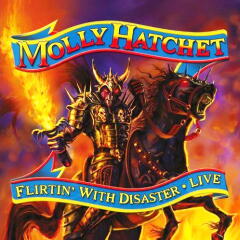
"Flirtin' with Disaster" was written by Danny Joe Brown, Dave Hlubek and Banner Thomas, and appears as the first cut on side two of Molly Hatchet's second studio album of the same name. Released as a single in March 1980, the song went to #42 on the Billboard Hot 100 Singles chart. Over the years, the song has appeared in motion pictures, television shows and video games. Personnel on the record were: Danny Joe Brown (vocals), Dave Hlubek (guitar), Steve Holland (guitar), Duane Roland (guitar), Banner Thomas (bass) and Bruce Crump (drums).
The Flirtin' with Disaster album was recorded at Bee Jay Recording Studios in Orlando, and the Record Plant in Los Angeles in 1979, with Tom Werman producing. Released in September 1979, the record went to #19 on the Billboard Top 200 Albums chart. It has been certified 2x Platinum by the Recording Industry Association of America. Three singles were released from Flirtin' with Disaster, which would become Molly Hatchet's best-selling album.
Molly Hatchet is an American Southern rock band formed in Jacksonville, FL, in 1971 by guitarist Dave Hlubek. They have released 14 studio albums, seven live albums, six compilation albums and nine singles. Thirty-one people have passed through Molly Hatchet's ranks since its inception in 1971. Original member Danny Joe Brown died in March 2005, Duane Roland in May 2006, Bruce Crump in March 2016, Banner Thomas in April 2017, and guitarist and founding member Dave Hlubek in September 2017. A version of Molly Hatchet with no original members will start a new U.S. tour on April 26 (subject to change due to COVID-19).







Comments
As far as the large ATB fleet is concerned, there are several in active service which are at or over the 40year hull mark. Most of these vessels do not pass vetting requirements of the oil majors and within the next 3 or 4 years, you will see these units either scrapped or sold off onto the international market where restrictions are not as stringent as they are here in the US. This will stabilize chartering rates and eventually will get back TCE's to normalization. I dont see rates hitting what they were over the past 3 years when certain MR's were over 100k/day, but return back to 70k/day range.