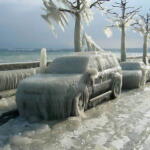
Natural gas wellhead freeze-off happens when outside temperatures drop below freezing in producing fields. . If the wellhead is not protected then water and other liquids in the gas can freeze and block the flow of gas. The consequences range from minor inconvenience to major reductions in natural gas production and power outages affecting millions of customers. Today we put on our hat and gloves to find out how, why and when freeze-offs happen.
We have talked before here about the impact of weather events on natural gas production in reference to hurricanes in the Gulf of Mexico (see Oil Production Hit Harder by Isaac than Natural Gas). A less often discussed but equally disruptive weather event is a blast of very cold weather across the gas patch. For example, during the first week of February 2011, the Southwest US experienced unseasonably cold and windy weather. Temperatures fell by 50 ° F over an eighteen‐hour period in some Texas cities. Lows during the period were in the teens for five consecutive mornings and there were many hours of below freezing temperatures throughout Texas and New Mexico.
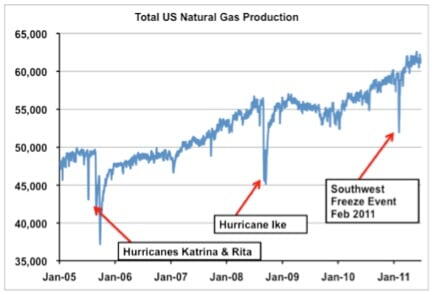
Those low temperatures resulted in widespread disruption of utility services including rolling power blackouts and the loss of domestic natural gas service to communities in Texas and New Mexico. These disruptions were in large part a consequence of the loss of natural gas production and processing capabilities that resulted from the freeze. Production losses in cold weather are caused by wellhead freeze-off – a phenomena where low temperatures crystallize the small amounts of water produced with natural gas, forcing blockages at the wellhead. We will get into how that happens in a bit but first lets recap how damaging an event like this can be. Natural gas production was effected in five Southwest basins – the Barnett, Eagle Ford, Haynesville, Anadarko and Permian. For the period February 1 through February 5, 2011 an estimated 14.8 Bcf of production was lost. You can see the impact on the chart below showing total US production. The February 2011 freeze event was similar to that of a major hurricane such as Ike in 2008. Except of course that the freeze-offs occur when it is coldest, and therefore the market impact is the greatest.
About the song
“Cold As Ice” was written by Lou Gramm and Mick Jones and appears as the second song on Foreigner’s debut album, Foreigner. Released as a single in July 1977, the song went to #6 on the Billboard Hot 100 Singles chart. Personnel on the record were: Lou Gramm (lead vocals), Mick Jones (lead guitar, piano, backing vocals), Ian McDonald (rhythm guitar, mellotron, backing vocals), Al Greenwood (organ, synthesizer), Ed Gagliardi (bass, backing vocals), Dennis Elliott (drums), and Ian Lloyd (backing vocals).
Foreigner was the self-titled debut album by the British-American band of the same name. It was recorded in November 1976 at The Hit Factory and Atlantic Recording Studios in New York City, with John Sinclair, Gary Lyons, Mick Jones and Ian McDonald producing. Released in March 1977, the album went to #4 on the Billboard Top 200 Albums chart. It has been certified 5X Platinum by the Recording Industry Association of America. Three singles were released from the LP.
Foreigner is a British-American rock band formed in New York City in 1976 by Brits Mick Jones and Ian McDonald, with New Yorker Lou Gramm. Jones had previously been in Spooky Tooth, and McDonald had been a member of King Crimson. They recruited Americans Al Greenwood, Ed Gagliardi and Dennis Elliot to complete the band. Jones came up with the name Foreigner to reflect the British-American connection. They have released nine studio albums, seven live albums, 20 compilation albums, and 47 singles, and have sold over 50 million records worldwide. Thirty-eight members have passed through the ranks of the band since its inception. Original member Mick Jones, along with ex-Dokken bassist Jeff PIlson, ex-Hurricane singer Kelly Hanson, and four other musicians still tour as Foreigner. They are slated to start a North American tour in March 2024.