


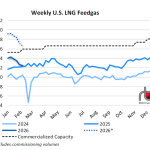
U.S. LNG feedgas demand is rebounding after Winter Storm Fern, with most Gulf Coast terminals returning to pre-storm operations within days.
Before Winter Storm Fern, U.S. LNG feedgas demand in January averaged about 18.8 Bcf/d, which dropped to 10.9 Bcf/d on January 26, before bouncing back. By January 27, most terminals had returned to pre-storm operations. Feedgas demand averaged 16.5 Bcf/d last week, down 0.7 Bcf/d from the previous week (see the blue-dotted line on the left side of the chart below).
Freeport Train 3 tripped offline as the storm's impact unwound, delaying full recovery there by a few days, but the terminal is back to full operations. Feedgas intake at the commissioning Plaquemines has been somewhat volatile since the storm, bouncing between 3.5 Bcf/d and 4 Bcf/d. The other Gulf Coast terminals have resumed pre-storm intake levels, but Cove Point and Elba Island are still operating well below full capacity.
While temperatures have mostly recovered, the cold lingered in the Northeast and Southeast and prices in those markets were still elevated at the end of last week. During cold weather, LNG feedgas demand declines due to operational issues and financial incentives. Stay tuned to the LNG Voyager Weekly Report for more insights on the LNG industry.
