


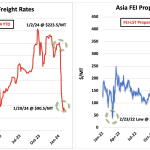
Spot LPG VLGC (Very Large Gas Carrier) freight rates out of the U.S. Gulf Coast to Asia have collapsed since the beginning of the year primarily due to a significant narrowing of the spread between Far East Asia (FEI) propane prices and Mont Belvieu. Spot freight rates for propane shipments from Houston to Chiba, Japan (via Panama Canal) have plunged by $133/MT (25.5 c/gal), or ~60%, since the beginning of the year, settling at $90.5/MT, or 17.4 c/gal, as of January 29. As the left-hand chart below illustrates, spot VLGC freight rates have been volatile over the last two years. Rates started the year at ~$224/MT, or 42.9 c/gal, just $30/MT, or 5.8%, below the September 2023 peak. The steep decline in freight rates has kept the US-Asia export Arb open (economic) despite a significant narrowing of the Asia FEI-Mont Belvieu propane price differential. As shown on the right-hand chart below, since the beginning of the year the spread between Asia FEI and Mont Belvieu propane has declined by 43%, or $130/MT (25 c/gal). As of January 29, the U.S. – Asia propane Arb was narrowly open by $7/MT, or 1.4 c/gal, after subtracting freight and terminal costs.
Featured Articles
- Analyst Insight
Spot LPG VLGC Freight Rates Soar
Spot LPG VLGC freight rates peaked at $254/MT, or 48.7 c/gal, on September 25, up 82%, or $114/MT, since the beginning of the year. And the surge in fright can’t be blamed on delays at the Panama Canal this time. Currently, wait times at the Panama Canal (Neopanamax) are only 7 days northbound and 2 days southbound.
- Analyst Insight
US Propane Exports Eke Into The New Year as the U.S-Asia Arb Shrinks
The U.S.-Asia propane export arb remained open in early January but narrowed as Mont Belvieu prices soared, shrinking the spread to Asia FEI propane, which was only partially offset by a collapse in freight rates.


- Blog
Let's Get Physical, Part 2 - A Step-by-Step Guide to Making an International LPG Trade
In October, some 45 MMbbl of liquefied petroleum gases (LPGs) were loaded onto ships and sent out from U.S. ports, more than 80% of it from Texas Gulf Coast terminals. Most propane and normal butane exports are tied to long-term deals between U.S. suppliers and overseas buyers, but a substantial share involves third-party LPG traders who cut deals to buy LPG, arrange for shipping and terminaling, then sell the LPG to buyers in distant lands. How exactly does all this happen? Today, we continue a series on how U.S.-sourced LPG makes its way to Asia, Europe and other key export markets.
