



Devon Energy used its Q3 2026 earnings call to lay out a plan for low single-digit oil growth over the next year, a change from a year ago when CEO Clay Gaspar said legacy Devon felt “the world is pretty saturated in oil” and doubted the need for its “incremental barrels.” The Coterra merger and this year’s New Mexico federal lease purchase changed that, giving Devon “12-plus years” of drilling inventory.
Devon’s initial 2027 outlook is ~525 Mbbl/d of oil, about 2% above what the same assets will produce this year, excluding the Eagle Ford, which Devon is selling. It will spend less to get there, with about 75% of spending going to the Permian, up from 63%. CFO Shane Young said low single-digit growth “actually maximized free cash flow” and that the plan holds up “down to $60, $70 a barrel.” First wells on the federal acreage are expected around mid-2027, with meaningful production in early 2028. Oil hit a record 553 Mbbl/d in Q3, Q4 guidance is 550-560 Mbbl/d, and full-year 2026 guidance is unchanged at 495-505 Mbbl/d (Coterra counted from May).
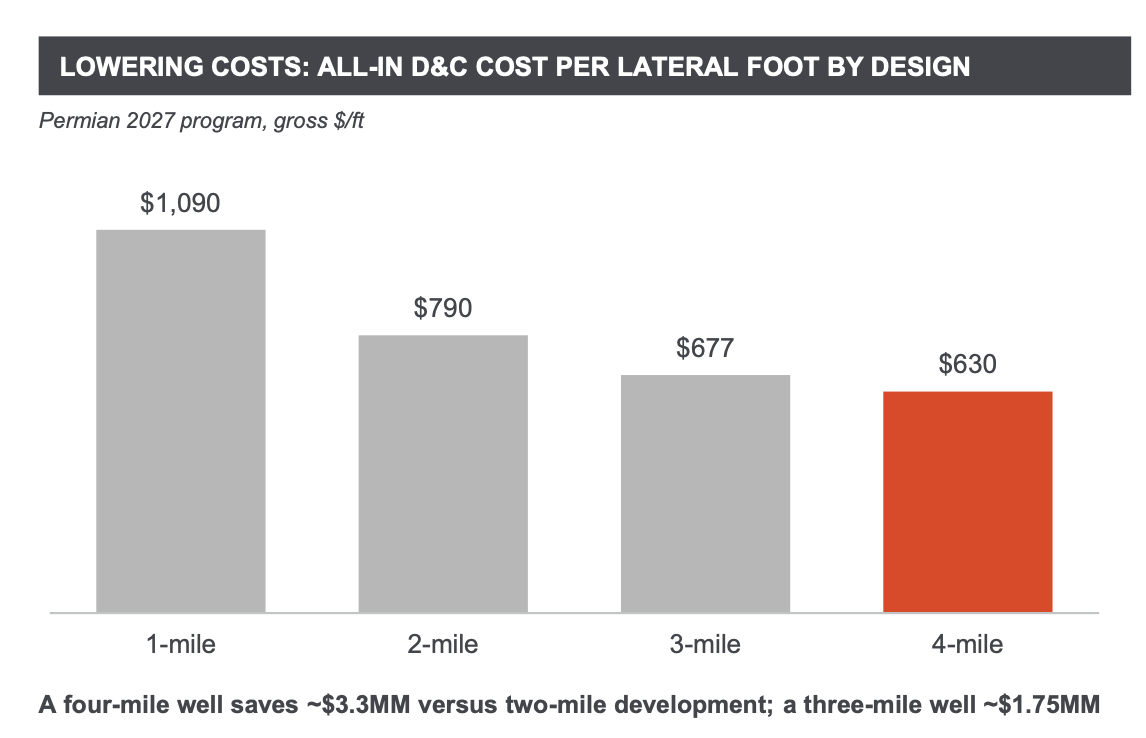
Longer wells are doing most of the work (see chart below). Average well length rises more than 10% in 2027, including 53 four-mile wells. EVP of Operations Blake Sirgo expects all-in well costs around $750 per foot, and Devon will use a chemical additive that raised oil output per foot 18% in early Delaware tests on more than 200 wells next year. Gas is the exception. Devon has “tried to really, really limit” its Permian gas production because prices “aren’t where we wanted them to be,” Gaspar said, and won’t grow it until the Solitude Pipeline, in which it holds a 25% stake, carries that gas to the Gulf Coast. Once it does, the oil “will probably carry the economics and you essentially get all the gas for free.”
Source: Devon
