


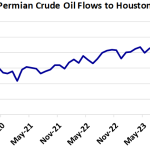
Permian Basin crude oil flows to Houston rose in May after two consecutive months of decline, following a six-month growth streak that culminated in a record set in February, according to recently released data from the Texas Railroad Commission. May volumes totaled 2.58 MMb/d (see blue line on the chart below), marking a 245 Mb/d increase from April. With pipelines to Corpus Christi essentially full, most of the production growth in the Permian has been directed toward Houston.
Currently, four pipelines serve as the route for Permian crude bound for Houston — Midland-to-ECHO I (620 Mb/d), Wink to Webster (1.5 MMb/d, of which Midland-to-ECHO III makes up 450 Mb/d representing Enterprise’s undivided interest), Longhorn (275 Mb/d) and BridgeTex (440 Mb/d). In May, all pipelines saw an increase. ONEOK’s BridgeTex and Longhorn recorded gains of 64 Mb/d and 117 Mb/d, respectively. Enterprise’s Midland-to-ECHO I increased 27 Mb/d, while Midland-to-ECHO III was up by 364 b/d, maintaining full capacity for the seventh consecutive month. The remaining Wink-to-Webster volumes saw a slight increase of 38 Mb/d, bringing utilization to nearly 92%.
Earlier this year, Enterprise converted its Midland-to-ECHO II pipeline to NGL service, temporarily removing 220 Mb/d of crude oil capacity from the Permian to Houston corridor. This conversion contributed to the temporary decline in Houston-bound volumes earlier in 2024. The pipeline is expected to revert to crude service once Enterprise’s Bahia NGL pipeline comes online in mid-2025. For now, BridgeTex remains the least utilized among the Houston-bound pipelines (a topic of an upcoming blog).
