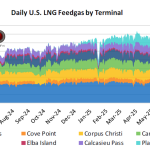
U.S. LNG feedgas demand slipped last week to its lowest level since mid-December, driven by ongoing maintenance at Sabine Pass and Cameron.
Daily U.S. LNG feedgas demand averaged 13.28 Bcf/d, down 0.91 Bcf/d week-on-week. Sabine Pass feedgas was below 3 Bcf/d for the week, with two trains offline for maintenance. Maintenance also appears to be ongoing at Cameron, where one train remains offline. Although pipeline maintenance on the Cameron Interstate Pipeline ended on May 30, feedgas intake has not yet returned to normal, indicating work is still ongoing.
Feedgas intake at Corpus Christi ranged from 1.4 Bcf/d to 2.05 Bcf/d last week (see chart below), compared to its usual level of 2.18 Bcf/d. Intake has been somewhat rocky all spring. We are unsure of the reasons for the volatility but it’s possible Corpus Christi is taking additional feedgas from the ADCC Pipeline for the Stage III project and the legacy terminal. ADCC Pipeline is an intrastate pipeline and does not report flow data.
The Corpus Christi Pipeline also experienced several short, unplanned maintenance events in the second half of May, disrupting feedgas intake. LNG output from the terminal was lower in May compared to April. It remains unclear whether additional maintenance is occurring at the terminal.
Freeport LNG’s Train 2 tripped offline on June 3 but was operating fully the rest of last week. Cove Point, Elba Island, and Calcasieu Pass were all operating at near full levels. Feedgas deliveries to the commissioning Plaquemines terminal were up slightly from the previous week and are currently around 2.6 Bcf/d. Plaquemines received FERC approval last week to commission Liquefaction Block 12, meaning more than half the terminal is now producing LNG, and feedgas intake is expected to increase in the second half of this year. For more insight on U.S. LNG Feedgas, see the Weekly LNG Voyager.