


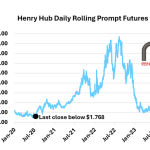
The March natural gas futures contract fell for the fifth consecutive trading day on Monday (2/12) to a closing price of $1.768/MMBtu – down more than 33 cents in the past eight trading days. Monday’s close is the lowest daily settlement price since July 2020 in the depths of the Covid crisis. That era observed an enormous drop in supply that ultimately helped the price of natural gas to recover. U.S. Lower 48 gas production plunged from an average of 94.3 Bcf/d in March 2020 to 88.8 Bcf/d in October of that year. In contrast, production is still riding high this year and has averaged 104.2 Bcf/d over the past 10 days. Unlike in 2020, healthy crude prices and their effect on associated gas will prevent such a swift collapse in overall gas production.
Featured Articles


Arctic Shuffle - February Polar Vortex Effect Puts $3/MMBtu Gas Prices Back in Play
Weather is the perpetual wildcard in the natural gas market, but it’s been particularly shifty this winter, keeping market participants — and weather forecasters, for that matter — on their toes. Gas futures prices started this season at $3.30-plus/MMBtu, but then endured some of the warmest weather on record (in November and January), including a couple of polar vortex head fakes over the past month or so — weather forecasts at times in January started off much colder but ultimately reversed course. Prompt CME/NYMEX Henry Hub futures prices have seesawed as a result. Despite the weather setbacks, however, prices have held on in the $2.40-$2.70/MMBtu range through much of winter and averaged more than $0.60/MMBtu higher year-on-year in January. And, with an Arctic blast set to unfurl across the Lower 48 this week, prices last Friday topped $3/MMBtu again in intraday trading before settling in the high-$2.80s/MMBtu Friday and Monday. Today, we examine the supply-demand factors underlying the recent price action, and prospects for sustained $3/MMBtu gas prices.


Heat of the Moment - High Gas Production, Historically Low Heating Demand Keep a Lid on Prices
So far this winter, front-month CME/NYMEX natural gas futures have fallen, risen and fallen again but, until their most recent dip, generally remained within the same $2.30-to-$3.30/MMBtu range where they have been lingering since mid-2023. With production sustaining near-record levels, LNG export volumes down from the winter highs, and temperatures back to normal, the supply of gas remains plentiful — a bearish scenario. In today’s RBN blog, we look at why there’s been a lid on natural gas prices — and the odds that the situation might change before the rapidly-approaching end of the winter season.


Oops, (Winter's) Out of Time - Natural Gas Buyers Party Like It's 1999
After holding above $2/MMBtu in the first half of January, the CME/NYMEX February natural gas futures contract caved in this week, closing Tuesday and Wednesday at $1.895/MMBtu and $1.905/MMBtu, respectively. The last time we saw prices this low was in March 2016. But to see such levels trading in January, typically one of the coldest and highest-demand months of the year, you’d have to go back more than two decades — to 1999. Today, we explain the fundamentals behind the price collapse earlier this week and its implications for the 2020 gas market.
