


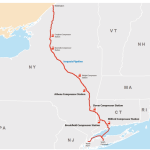
The State of New York’s Department of Environmental Conservation approved permits last Friday for the Enhancement by Compression project on the Iroquois Gas Transmission Pipeline. The project will expand two compressor stations in upstate New York and one in Connecticut so that an additional 125 MMcf/d of natural gas can flow into Southern Connecticut and New York City. The New York City region saw constrained supply during January’s winter storm, when prices on Transco Zone 6 New York hit $97.895/MMBtu according to data from Natural Gas Intelligence (NGI). Iroquois Zone 2 prices soared to $37.055/MMBtu that day as cold weather caused a spike in gas demand. The company intends to add the new compression in time for the winter of 2027-28.
Featured Articles


- Blog
Too Much Pipe On My Hands? - Marcellus/Utica Takeaway Capacity to New England and the Mid-Atlantic States
The Northeast natural gas market in recent years has been defined by its lack of sufficient infrastructure for growing production in the region. Pipeline takeaway capacity constraints have restricted production growth and driven Northeast prices to the lowest in the country. But could that soon change? With drilling activity slowing and 18 Bcf/d of takeaway due in-service over the next few years, is it possible the Northeast takeaway capacity will get overbuilt? Today, we continue our look at how pipeline takeaway capacity will stack up against Northeast production.


- Blog
In a Northeast Minute...Everything Can Change - Marcellus/Utica Takeaway Capacity to the East
Since 2013, nearly 3.0 Bcf/d of natural gas pipeline capacity has been added from Appalachia to the heavily populated, hard-to-reach demand centers along the East Coast. And another nearly 3.0 Bcf/d is in the works. The need for gas supply reliability in the heavily populated East, along with producers’ need to move their gas to market, is driving these expansions. But concentrated population centers, along with the geography, geology and regulatory environment of the area, all also make it tough and expensive for upgrading, expanding and developing the gas transportation system. Many of the proposed projects have been delayed or canceled as a result. Today, we provide an update on eastbound pipeline expansions from Appalachia.


- Blog
The Heat Is On - Algonquin, Transco Pipeline Expansions Feed More Marcellus Gas to New England, New York Markets
Several large-scale gas pipeline expansions targeting the New England and New York City markets have been sidelined in the past year, either due to insufficient financial backing or the challenges of regulatory rigmarole in the region. But in recent weeks, a couple of smaller-scale projects along existing rights-of-way have managed to cross the finish line, allowing incremental gas supplies to trickle into the region. The new pipeline capacity will provide natural gas utilities and power generators in the region with greater access to additional gas supplies from the nearby Marcellus Shale this winter. Today, we look at recent capacity additions and their potential impacts.
