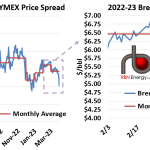
On the final day of May trading for Brent on Friday, the differential between Brent and WTI dropped to the lowest level in 2023, down to $4.10/bbl. The graph on the left below shows the differential since January 2022, indicating that the spread was narrow for the first half of 2022, then widened to an average of $6.70/bbl from July 2022 through the end of the year. At that point the differential narrowed briefly, then moved back to about $6.30 through February. But in March the differential started to weaken, finally collapsing late last week.
The collapse during the week was due to a $6.41/bbl increase in WTI for the week, while Brent increased only by $4.78/bbl. This is an indication of the relative strength of prompt WTI barrels in Cushing. Cushing has also increased significantly relative to all other U.S. light sweet crudes over the past few weeks.
If the differential stays narrow, the arb should discourage the high level of U.S. crude exports as international buyers reduce tanker shipments.